
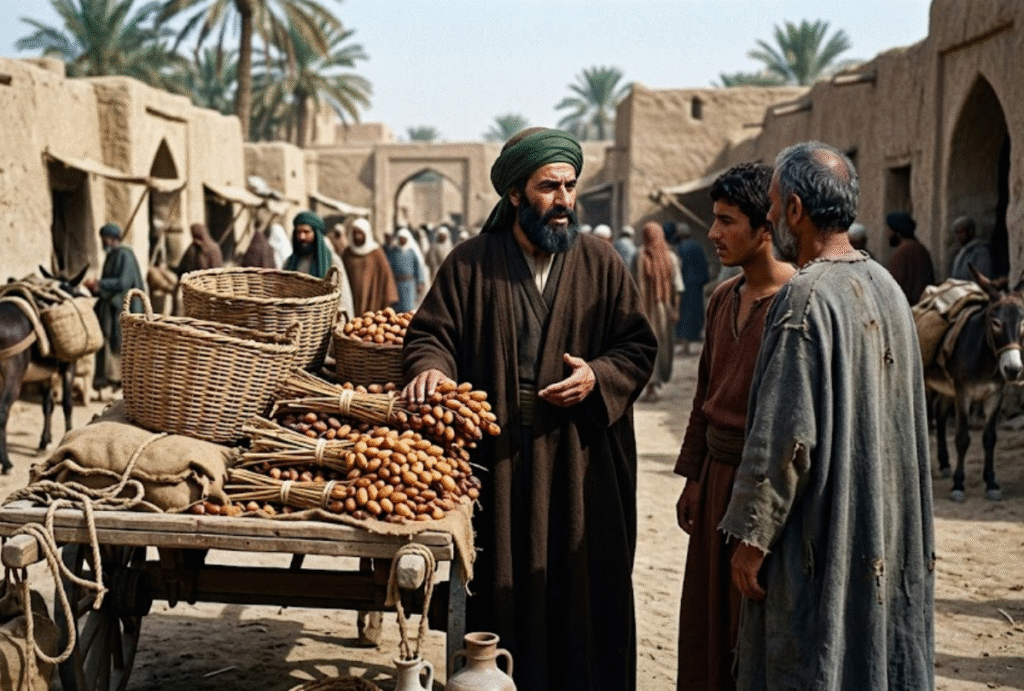
Maytham al-Tammar is remembered as one of the most devoted companions of Imam Ali (as), known for his unwavering faith, humility, and courage.
His life reflects deep loyalty to truth and sacrifice in the face of oppression.
Born in humble circumstances and raised in hardship, he rose to become a respected figure in early Islamic history.
His story is often shared as an example of steadfast belief and moral strength, showing how faith can elevate a person beyond social status or origin.
Who was Maytham al-Tammar?
Maytham al-Tammar, whose full name was Maytham ibn Yahya al-Asadi al-Kufi, was originally of Persian origin and born in Nihrawan near Kufa.
He worked as a date seller in the marketplace, which is why he was given the title “al-Tammar.”
Despite his humble occupation, he became widely known for his spiritual insight and close connection to Imam Ali (as).
Early Life and Freedom
Maytham was born into difficult circumstances and was later enslaved by a woman from the Banu Asad tribe.
His life changed when Imam Ali (as) purchased him and freed him purely for the sake of Allah (swt).
Imam Ali (as) even addressed him by his real name, restoring his identity and dignity.
This moment marked the beginning of a lifelong bond built on faith, respect, and spiritual guidance.
Relationship with Imam Ali (as)
Maytham became one of the closest and most loyal companions of Imam Ali (as).
The Imam (as) would often visit him in the marketplace and sit with him openly, teaching people that honour is not defined by wealth or status but by faith and character.
He was part of the circle of believers who remained firm in their devotion even during political turmoil.
Knowledge and Spiritual Rank
Imam Ali (as) taught Maytham deep knowledge of the Quran and spiritual interpretation.
Over time, he became known for his wisdom, and even senior companions would benefit from his insights.
His understanding of faith was not only intellectual but deeply practical, shaping how he lived and served others.
Prophecy of His Martyrdom
Imam Ali (as) foretold Maytham’s fate in detail:
“O Maytham! After my death you will be seized and will be hanged. Then on the preceding day blood shall ooze from your nose and mouth, which will dye your beard. Then on the third day a weapon will be pierced in your stomach, which will result in your death, thus look forward to that day. The place where you shall be hanged is facing the house of Amr ibn Hurayth. You shall be the tenth one from among those people who shall be hanged, while the timber of your gallow will be the shortest among all, and it will be nearer to the ground. And I shall show you the palm-tree on whose trunk you shall be hanged.”
Nafasul Mahmum
Maytham accepted this destiny with patience and certainty.
Quranic Reflection on His Life
A verse that strongly reflects his steadfastness is:
“Among the believers are men who are true to the covenant that they had made with Allah (swt); so among them is one who has fulfilled his vow (of standing steadfast till death) and among them is one who still waits (for the fulfillment of his vow), and, (unlike the hypocrites,) they have not changed (in the least in their steadfastness).”
Surah Al-Kahf, Ayah 23
This verse reflects Maytham’s unwavering commitment to truth and his refusal to change under pressure.
Martyrdom and Legacy
Maytham was later arrested under the rule of Ubaydallah ibn Ziyad (la) in Kufa.
Despite threats, he continued to speak about the virtues of Imam Ali (as).
Eventually, he was executed exactly as foretold.
His life stands as a powerful reminder that true honour lies in faith, sincerity, and courage.
His legacy continues to inspire those who value truth over comfort and conviction over fear.
Frequently Asked Questions
Maytham al-Tammar was a companion of Imam Ali (as), known for his loyalty, knowledge, and martyrdom in Kufa.
He was called “al-Tammar” because he worked as a date seller in the marketplace.
He was one of Imam Ali’s (as) closest companions and students, deeply trusted for his faith and character.
Imam Ali (as) foretold in detail how Maytham would be martyred and where it would take place.
Surah Al-Ahzab (33:23) reflects his steadfastness and loyalty to his covenant with Allah (swt).
He is remembered as a symbol of truth, sacrifice, and unwavering faith in the face of oppression.
More from blog

Bridging the Digital Divide Through Education
Discover how education and technology can help bridge the digital divide and create equal learning opportunities. Support children with the tools for…

Can Sadaqah Be More Than Money?
Sadaqah isn't only about giving money. Discover how your time, kindness, knowledge and actions can become acts of charity in Islam with…

The Future Starts with Education
Invest in education and help vulnerable children build skills, confidence and opportunity. Support The Zahra Trust’s Back to School appeal today.