
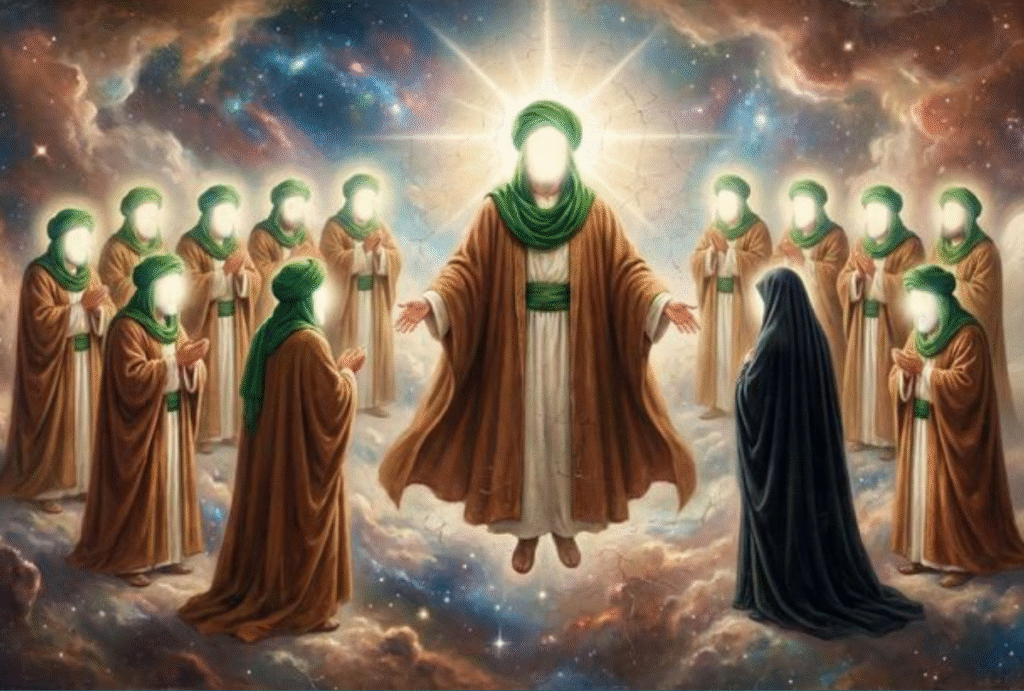
After the passing of Prophet Muhammad (saww), the question of leadership became central to the future of Islam.
For Shia Muslims, this leadership is not merely political but deeply spiritual and divinely guided.
This belief is known as the concept of Imamate.
It provides a framework through which guidance continues after prophethood.
Understanding this concept helps explain many aspects of Shia belief and practice.
What is Imamate? How is an Imam chosen?
In Shia understanding, the Imamate refers to a system of leadership appointed by Allah (swt).
It is not based on election or popular opinion but on divine selection.
This selection is known as nass, where each Imam is designated by the previous one under divine instruction.
The Imam serves as a guide who preserves the true teachings of Islam.
This idea finds support in the Quran, where leadership is shown as a divine role.
This is illustrated in the story of Prophet Ibrahim (as), who was tested and then elevated by Allah (swt) to a position of leadership:
“Verily, I make you an Imam (guide, leader) for the people.”
Surah Al-Baqarah, Ayah 124
The role and importance of the Imam
The Imam holds both spiritual and religious authority within the faith.
They interpret the Quran and ensure that its message remains clear and protected.
Their role also includes guiding believers in matters of ethics, justice, and daily life.
Obedience to rightful authority is emphasised in the Quran as part of faith.
This highlights the importance of recognising and following divinely appointed leaders.
The Quran states:
“O you who believe! Obey Allah (swt) and obey the Messenger (saww) and those who are vested with authority from among you.”
Surah An-Nisa, Ayah 59
The lineage of the Imams
The line of Imams begins with Imam Ali (as) and Sayyida Fatima (sa).
It continues through the family of the Prophet (saww), known as the Ahlulbayt (as).
Each Imam is believed to possess special knowledge and moral integrity.
This lineage ensures continuity of divine guidance across generations.
Their lives serve as examples of faith, patience, and devotion.
The concept of guardianship is also highlighted in the Quran:
“Your guardian is only Allah (swt), His Messenger (saww) and the believers who perform the prayer and pay the alms while bowing down in prayer.”
Surah Al-Ma’idah, Ayah 55
The occultation of the Twelfth Imam (ajtfs)
In Twelver Shia belief, the twelfth Imam, Imam al-Mahdi (ajtfs) is currently in occultation.
This means he is alive but not publicly visible.
Despite this, he continues to provide spiritual guidance.
His eventual return is awaited as a time of justice and restoration.
This belief maintains hope and continuity within the faith.
This idea is reinforced in hadith, emphasising the necessity of the Imam’s presence.
Imam al-Sadiq (as) is reported to have said:
“If the earth were to remain without an Imam, it would perish.”
Al-Kafi, v.1, p.179, n.10)
The centrality of Imamate in faith
Imamate is not a secondary belief but a central pillar in Shia Islam.
It shapes how believers understand authority, guidance, and devotion.
The recognition of the Imam is closely tied to the completeness of one’s faith.
It also strengthens the connection to the teachings of the Prophet (saww).
This highlights its importance in both belief and practice.
Imam al-Baqir (as) is reported to have said:
“Islam is based on five: prayer, alms, fasting, the obligatory pilgrimage (Hajj), and the divine guardianship (of the Imams from the household of the Prophet). And no other issue has been called for as much as divine guardianship.”
Al-Kafi, v.3, p.18, n.2
Connection to the Prophet (saww) and the Ahlulbayt (as)
The Imams are the direct descendants of the Prophet (saww) through his son-in-law and daughter, Imam Ali (as) and Lady Fatima (sa),
This connection ensures that the message of Islam remains authentic and protected.
The Prophet (saww) emphasised the importance of holding firmly to both the Quran and his household (as).
This forms a foundation for understanding guidance in Shia Islam.
It also highlights the enduring relationship between revelation and leadership.
The Prophet (saww) is reported to have said:
“Verily I leave behind among you the two weighty things, which as long as you continue to adhere to, you will never go astray after me, and one of which is greater than the other. The Book of Allah (saww) is the rope stretched from the heavens to the earth, and my progeny, my household (as). Behold, verily they will never separate from each other until they meet me at the Heavenly Waters.”
Bihar al-Anwar, v.23, p.106, n.7
Knowing the Imam
Recognising the Imam is considered essential in Shia belief.
It reflects an awareness of divinely guided leadership.
Without this recognition, one risks misunderstanding the path of faith.
This idea stresses the importance of knowledge and connection.
It also reinforces personal responsibility in belief.
The Prophet (saww) is reported to have said:
“Whoever dies without knowing his Imam has died a pagan (pre-Islamic) death.”
Bihar al-Anwar, v.23, p.76, n.1
Final Reflections
The concept of Imamate in Shia Islam represents a continuation of divine guidance after Prophet Muhammad (saww).
It combines spiritual authority with moral responsibility.
Through the Imams, believers find clarity and direction in their faith.
The Quran and hadith both emphasise the importance of this leadership.
Understanding the Imamate offers deeper insight into the foundations of Shia belief.
Frequently Asked Questions
The concept of Imamate refers to divinely appointed leadership after Prophet Muhammad (saww). In Shia belief, Imams are chosen by Allah (swt) to guide humanity. They hold both spiritual and religious authority. Their role is to preserve and interpret the teachings of Islam. This makes them central figures in the faith.
An Imam is chosen through divine designation, known as nass. This means Allah (swt) appoints the Imam, often announced by the Prophet (saww) or the previous Imam. It is not a decision made by people. This ensures that leadership remains pure and guided. It also distinguishes Imamate from political systems.
The Imamate provides continuous guidance after the Prophet (saww). It ensures that the teachings of Islam are preserved correctly. It also offers a moral and spiritual framework for believers. Without it, understanding of faith could become unclear. This is why it is considered essential.
The Imams are the descendants of the Prophet (saww) through Imam Ali (as) and Sayyida Fatima (sa). In Twelver Shia belief, there are twelve Imams. Each one is chosen by Allah (swt) and possesses special knowledge. They serve as guides for the community. Their lives are examples of faith and dedication.
The occultation refers to the hidden state of Imam al-Mahdi (ajtfs). Shia Muslims believe he is alive but not visible to the public. He continues to provide spiritual guidance. His return is expected in the future. This belief offers hope and continuity.
The Ahlulbayt (as) are the family of the Prophet (saww). In Shia Islam, they are central to leadership and guidance. The Imams come from this family. They are seen as protectors of the faith. Their teachings help preserve the true message of Islam.
More from blog

Bridging the Digital Divide Through Education
Discover how education and technology can help bridge the digital divide and create equal learning opportunities. Support children with the tools for…

Can Sadaqah Be More Than Money?
Sadaqah isn't only about giving money. Discover how your time, kindness, knowledge and actions can become acts of charity in Islam with…

The Future Starts with Education
Invest in education and help vulnerable children build skills, confidence and opportunity. Support The Zahra Trust’s Back to School appeal today.