
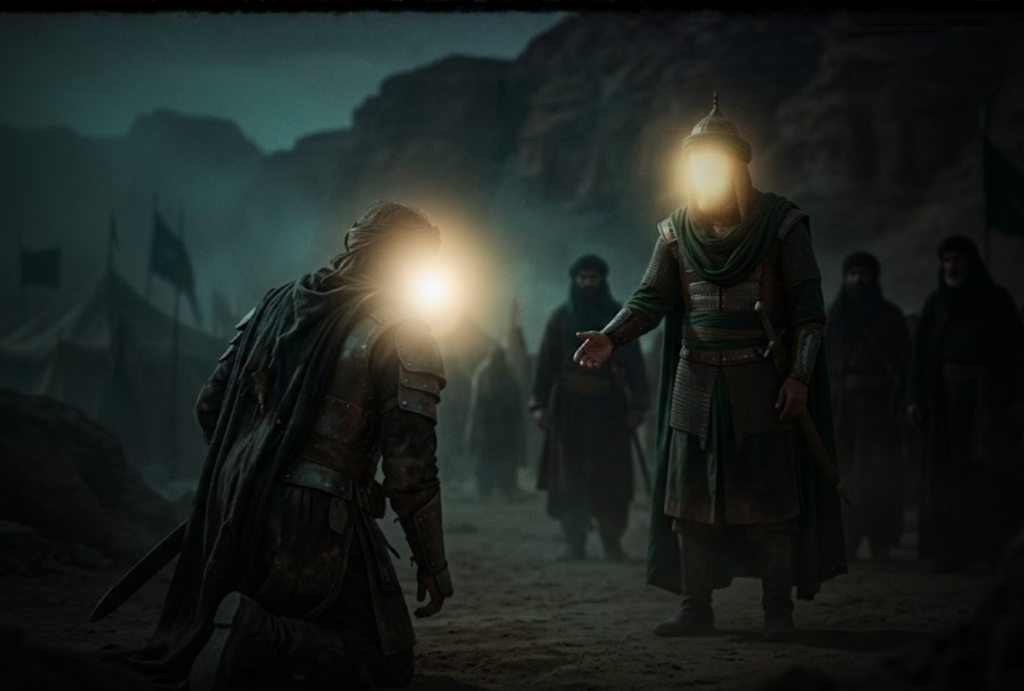
Muharram is a time of remembrance, reflection and renewal. As we commemorate the sacrifices made on the plains of Karbala, we are reminded that the story of Imam Hussain (as) and his companions is not only a historical account. It is a living source of guidance for every generation.
Among the most inspiring figures of Karbala is Hurr ibn Yazid al-Riyahi (as), a man whose journey demonstrates that no one is beyond the mercy of Allah (swt). His story is one of repentance, moral courage and spiritual transformation. Learning from Hurr’s story teaches us that even when we have made mistakes, the door to Allah’s (swt) mercy remains open.
Who was Hurr ibn Yazid al-Riyahi?
Hurr ibn Yazid al-Riyahi (as) was a respected commander in the army sent to intercept Imam Hussain (as) on his journey towards Kufa. He was entrusted with preventing the Imam (as) and his caravan from continuing their journey and was among the first figures involved in the events that ultimately led to Karbala.
Despite his military status and loyalty to the authorities of the time, Hurr was not an inherently cruel individual. As the situation unfolded and the reality of what was happening became clearer, his conscience began to awaken.
His story reminds us that people cannot always be defined by a single moment in their lives. What matters most is how they respond when truth becomes evident.
The moment that changed everything
As the Day of Ashura approached, Hurr found himself wrestling with an immense moral dilemma. He could see the character of Imam Hussain (as), the grandson of the Holy Prophet (saww), and he understood the gravity of the choices before him.
According to historical narrations, when Muhajir ibn Aus noticed Hurr’s unusual state and asked about it, Hurr replied:
“By Allah (swt). I am, at present, finding myself in the position of opting for either Heaven or Hell. By Allah (swt)! I will opt for nothing but Paradise; even if I were cut into pieces and then burnt.” (Lohoof)
These words reveal the depth of Hurr’s internal struggle. He recognised that the decision before him was not political or worldly. It was spiritual and eternal.
Many people experience moments when they know the right path but fear the consequences of following it. Hurr teaches us that true courage is not the absence of fear. True courage is choosing what is right despite that fear.
The power of sincere tawbah
One of the greatest lessons in learning from Hurr’s story is the transformative power of sincere repentance.
On the morning of Ashura, Hurr made a decision that would change his destiny forever. Leaving behind status, reputation and worldly security, he rode towards the camp of Imam Hussain (as).
Filled with remorse, he sought forgiveness for his role in the suffering endured by the Imam (as) and his family. His repentance was not merely verbal. It was demonstrated through action, humility and complete submission to Allah (swt).
In Islam, tawbah is more than feeling regret. It involves recognising one’s mistakes, turning away from wrongdoing and making a sincere commitment to change.
Hurr embodied each of these qualities. His example reminds us that repentance remains available regardless of our past. No matter how far a person may feel from Allah (swt), there is always a path back through sincerity and action.
Loyalty through the example of Hurr
The story of Hurr’s repentance reflects a broader principle found throughout the lives of the Ahlulbayt (as): the importance of choosing truth over personal comfort.
A powerful example can be seen in the life of Imam Ali (as). Throughout his life, Imam Ali (as) consistently upheld justice, even when doing so came at great personal cost. He never compromised principles for worldly gain and taught believers to stand firmly with truth regardless of circumstances.
Hurr’s decision on Ashura mirrored this spirit of unwavering commitment to what is right. Faced with a choice between worldly security and eternal success, he chose the path of righteousness.
This loyalty was not merely loyalty to an individual. It was loyalty to divine guidance, justice and the values that Imam Hussain (as) represented.
For believers today, this lesson remains deeply relevant. We are often faced with choices between convenience and principle. Learning from Hurr’s story encourages us to prioritise our relationship with Allah (swt) above temporary worldly concerns.
From commander to martyr
After joining Imam Hussain’s (as) camp, Hurr devoted himself entirely to defending the truth. The same courage that had once been used in service of an unjust cause was now redirected towards the path of righteousness.
He fought alongside the companions of Imam Hussain (as) and ultimately attained martyrdom on the Day of Ashura.
Before Hurr’s final breaths, Aba Abdillah (as) is reported to have said:
“You are indeed Hurr (Free) as your mother named you. You are free both in this world and in the Hereafter.” (Lohoof)
These words represent one of the most moving moments in the history of Karbala. Hurr’s freedom was not political or social. It was spiritual. He had freed himself from fear, ego and attachment to falsehood.
His transformation demonstrates that a person’s ending can be more important than their beginning. Through sincere repentance and steadfast faith, Hurr became one of the honoured martyrs of Karbala.
What Hurr’s story teaches us today
Hurr’s journey offers timeless lessons for Muslims seeking to strengthen their relationship with Allah (swt).
First, it teaches us that it is never too late to change. As long as life remains, the opportunity for repentance exists.
Second, it reminds us to listen to our conscience. Hurr’s transformation began when he honestly confronted the reality of his actions.
Third, it shows that repentance requires action. Real change involves more than words. It requires a genuine commitment to a different path.
Fourth, it demonstrates that standing for truth may involve sacrifice. Hurr gave up status, security and ultimately his life in defence of justice.
Finally, it teaches us that true freedom comes through obedience to Allah (swt). By choosing the path of righteousness, Hurr became worthy of the title “Free” in both this world and the Hereafter.
Turning mourning into mercy
The lessons of Karbala are not confined to remembrance alone. They inspire believers to translate love for Imam Hussain (as) into compassionate action.
To answer “Labbayk Ya Hussain” is to carry his message beyond remembrance.
This Muharram, let your grief become mercy for families facing hardship.
Across the world, many families continue to face poverty, displacement, conflict and humanitarian crises. Supporting emergency aid initiatives allows us to honour the values of compassion, sacrifice and service that define the legacy of Karbala.
Love for Imam Hussain (as) is not only remembered. It is lived through compassion and service.
Give in honour of Imam Hussain (as). Turn mourning into mercy and help provide urgent support to those who need it most.
Final reflections
Learning from Hurr’s story reminds us that the door of Allah’s (swt) mercy remains open until our final breath. His transformation from a commander opposing Imam Hussain (as) to one of Karbala’s most honoured martyrs stands as a powerful example of repentance, courage and faith.
As Allah (swt) tells us in the Holy Quran:
“Do not think of those who are slain in the way of Allah (swt) as dead; nay, rather they are alive (in the real sense – they are) with their Lord (and) are provided sustenance (by Him).” (3:169)
Hurr’s life demonstrates that true success lies not in worldly status but in responding to the call of truth. His legacy continues to inspire believers to return to Allah (swt), stand for justice and transform remembrance into meaningful action.
FAQs
Who was Hurr ibn Yazid al-Riyahi?
Hurr ibn Yazid al-Riyahi was a commander who initially intercepted Imam Hussain (as) on his journey to Kufa but later repented and joined the Imam’s (as) camp on the Day of Ashura.
Why is Hurr’s story important in Islam?
His story demonstrates the power of sincere repentance, moral courage and the limitless mercy of Allah (swt).
What does the name “Hurr” mean?
The name “Hurr” means “free”. Imam Hussain (as) affirmed this meaning when he described Hurr as free in both this world and the Hereafter.
What can we learn from Hurr’s repentance?
We learn that no one is beyond redemption and that sincere tawbah requires both remorse and meaningful action.
How did Hurr become a martyr?
After repenting and joining Imam Hussain’s (as) camp, Hurr fought in defence of truth and was martyred on the Day of Ashura.
How does Hurr’s story relate to our lives today?
His story encourages us to choose truth over convenience, listen to our conscience, seek forgiveness from Allah (swt) and take action when we recognise our mistakes.
More from blog

Bridging the Digital Divide Through Education
Discover how education and technology can help bridge the digital divide and create equal learning opportunities. Support children with the tools for…
Can Sadaqah Be More Than Money?
Sadaqah isn't only about giving money. Discover how your time, kindness, knowledge and actions can become acts of charity in Islam with…

The Future Starts with Education
Invest in education and help vulnerable children build skills, confidence and opportunity. Support The Zahra Trust’s Back to School appeal today.