
As Shahr Ramadan unfolds, many of us prepare iftar in familiar ways.
The gentle simmer of a pot, the scent of rice or bread warming in the kitchen, dates set aside ready to break the fast.
These moments feel ordinary, yet they are deeply meaningful.
At the same time, in another kitchen far from our own, a mother prepares iftar with the contents of a food parcel.
Her ingredients are simple. Her resources are limited.
Yet the intention is the same.
To nourish her children, to mark the end of the fast with warmth, and to welcome the blessings of the month of Ramadan with dignity.
Allah (swt) reminds us of this spirit of selflessness in the Holy Quran:
“And they feed the food, despite their desire for it, to the poor, the orphan, and the captive. (They gave away their food selflessly as if they were saying,) ‘We feed you only for Allah’s (swt) sake; we expect neither reward nor thanks from you.”
Surah Al-Insan, Verses 8-9
This is the heart of Shahr Ramadan food aid.
Turning staples into sustenance. Turning support into shared humanity.
Support food aid this Shahr Ramadan and help families break their fast with dignity.
When hunger shadows the month of mercy
For many families around the world, Shahr Ramadan begins with uncertainty.
Instead of planning meals, they worry about how to afford even a simple iftar.
Conflict, rising costs, displacement, and loss of income mean that food insecurity becomes a daily burden.
Iftar meals for families in need are not about abundance. They are about reassurance.
A warm dish. Enough to share. Enough to feel cared for during a sacred month meant for reflection, patience, and mercy.
From a parcel of ingredients to a table of mercy
Imam Ali (as) is reported to have said:
“The nourishment of the body is food whilst the nourishment of the soul is feeding others.”
Mishkat al-Anwar, n.325
Through Shahr Ramadan, The Zahra Trust provides food parcels designed to help families prepare familiar, nourishing meals at home.
Each parcel contains essential ingredients that reflect local cooking traditions, allowing families to observe Ramadan with dignity and care.
Food parcels in Kabul, Afghanistan
In Kabul, food parcels support families facing ongoing economic hardship, offering ingredients that can be transformed into comforting iftar meals.
Items included:
- Flour
- Rice
- Cooking oil
- Spaghetti
- Dates
- Tea
- Chickpeas
Food parcels in Kenya
In Kenya, food parcels provide staple ingredients that families rely on daily, particularly during Shahr Ramadan.
Items included:
- Maize flour
- Wheat flour
- Rice
- Cooking oil
- Salt
- Sugar
Food parcels across the MENA region and beyond
Across parts of the Middle East and North Africa (MENA), as well as countries including Burkina Faso, Tanzania, Thailand, and Bangladesh, food parcels are tailored to local diets and shared food traditions.
Items included:
- Rice
- Sugar
- Legumes and pulses
- Tea
- Dates
- Cooking oil
- Tomato paste
- Pasta
- Soy
A widow’s iftar in Kabul: Kabuli Pulao
One widow supported by The Zahra Trust lives on the western outskirts of Kabul with her two children.
Since losing her husband five years ago, she has relied on embroidery work and family support to meet basic needs.
Shahr Ramadan is a time of faith for her, but also one of careful planning.
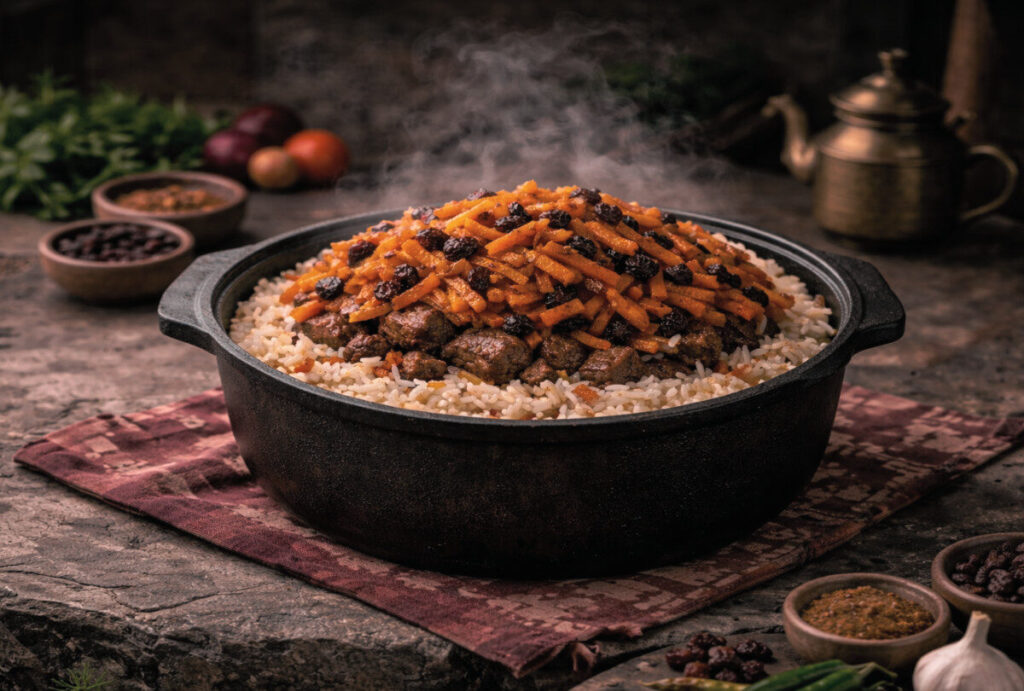
Using ingredients available through food aid, she prepares kabuli pulao for iftar.
Click here for the recipe she prepares for her family, shared as part of our Shahr Ramadan recipe collection.
Kabuli pulao is Afghanistan’s national dish.
Fragrant rice layered with tender meat, sweet carrots, and raisins.
It is often served on special occasions, and for her family, it brings familiarity and comfort during Shahr Ramadan evenings.
The dish begins with gently sautéed carrots and raisins, set aside until the final steaming.
Meat is cooked slowly with onions and spices until tender, with some of the broth reserved.
Rice is parboiled, layered with the meat, then topped with carrots and raisins before steaming on low heat.
When served, the rice is aromatic and filling.
For her children, it is more than a meal. It is reassurance at the end of a long day of fasting.
A shared vision for Shahr Ramadan
Imagine a world where no family approaches Shahr Ramadan with fear of hunger.
Where food parcels arrive not only as support, but as reassurance that they are remembered by the global community.
Every donation helps transform simple ingredients into nourishing iftar meals for families in need.
Imam al-Sadiq (as) is reported to have said:
“Whoever gives sadaqah during the month of Ramadan, Allah (swt) will avert seventy types of calamities from him.”
Wasail al-Shia, h.12341
From your kitchen to theirs
As you prepare iftar this Shahr Ramadan, remember that your generosity helps place real meals on real tables.
From food parcels to family kitchens, your support becomes nourishment, comfort, and hope.
Imam al-Baqir (as) is reported to have said:
“Any believer who provides iftar to another believer on a night in the month of Ramadan, Allah (swt) will write for him a reward equal to freeing a soul. And whoever provides iftar to him for the entire month of Ramadan, Allah (swt) will write for him a reward equal to freeing thirty believing souls, and he will have because of that an accepted supplication with Allah (swt).”
Wasail al-Shia, h.13052
Donate, share, and help ensure no family breaks their fast alone this Shahr Ramadan.
FAQ
Shahr Ramadan food aid provides families facing hardship with essential ingredients so they can prepare their own iftar meals throughout the month with dignity.
Food parcels are distributed to vulnerable families including widows, orphans, and households affected by poverty, conflict, or displacement.
Food parcels include staple items such as rice, flour, cooking oil, legumes, dates, and tea, adapted to local diets and traditions.
Food aid ensures families can break their fast with nourishment and peace of mind during a month centred on patience and compassion.
The Zahra Trust works with local teams to deliver food parcels directly to families, prioritising dignity and access.
You can donate, share awareness, and remember struggling families while preparing your own iftar meals.
More from blog
Bridging the Digital Divide Through Education
Discover how education and technology can help bridge the digital divide and create equal learning opportunities. Support children with the tools for…
Can Sadaqah Be More Than Money?
Sadaqah isn't only about giving money. Discover how your time, kindness, knowledge and actions can become acts of charity in Islam with…
The Future Starts with Education
Invest in education and help vulnerable children build skills, confidence and opportunity. Support The Zahra Trust’s Back to School appeal today.