
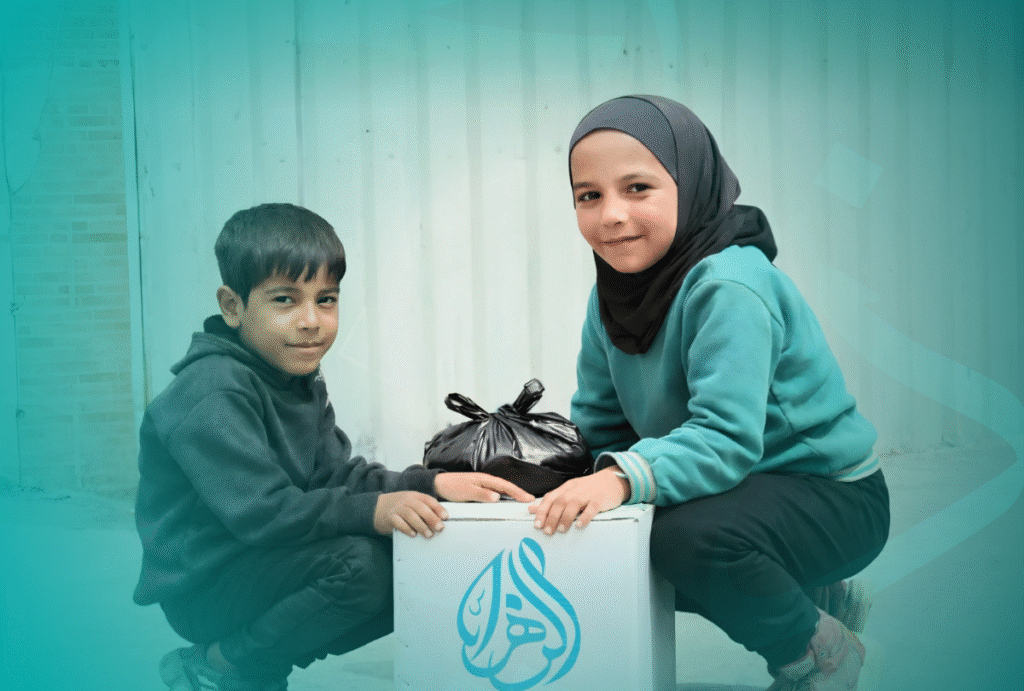
Every year during Eid al-Adha, Muslims around the world honour the legacy of Prophet Ibrahim (as) through the act of Qurbani, also known as Udhiyah.
More than a ritual sacrifice, Qurbani represents faith, obedience, compassion, and devotion to Allah (swt).
The tradition traces back to a remarkable moment in Islamic history when Prophet Ibrahim (as) was tested with a command unlike any other.
His willingness to submit completely to Allah’s (swt) will, alongside the patience and trust shown by his son, Prophet Ismail (as), continues to inspire Muslims today.
The story of Ibrahim (as) and Ismail (as)
A divine test
The foundation of Qurbani comes from the story of Prophet Ibrahim (as) and his son, Prophet Ismail (as), mentioned in the Quran.
After years of longing for a child, Ibrahim (as) was blessed with Ismail (as).
Yet Allah (swt) chose to test him in a profound way.
Allah (swt) says:
“And when (his son Ismail) reached the age when he could work with him, Ibrahim (as) said, ‘O my son! I have surely repeatedly seen in a dream that I am sacrificing you. So ponder (over it and let me know) what you think.’ He replied, ‘O my father! Do whatever you have been commanded (to do); you shall find me, God willing, of the patient ones.’”
Surah As-Saffat, Ayah 102
This moment highlights the extraordinary faith of both father and son.
Rather than resisting Allah’s (swt) command, Ismail (as) responded with patience and trust.
Completed submission
As Prophet Ibrahim (as) prepared to carry out the command, both he and Ismail (as) demonstrated complete submission to Allah (swt).
Allah (swt) says:
“So when they both (totally) submitted and Ibrahim (as) placed Ismail down with one side of the forehead on the ground, (We were pleased with their devotion) and (so) We called out to him saying: O Ibrahim! You have indeed made a dream come true! Surely this is how We reward the good-doers (by putting them at a higher test level so that they would deserve a greater reward).”
Surah As-Saffat, Ayah 103-105
The test was never about loss.
It was about sincerity, obedience, and unwavering faith.
A great sacrifice
At the final moment, Allah (swt) replaced Ismail (as) with a ram, showing His mercy and rewarding Ibrahim’s (as) devotion.
“Indeed this is a manifest test; and, (so) We ransomed and (replaced him) with a great sacrifice (in the form of a sheep).”
Surah As-Saffat, Ayah 106-107
This event became the foundation of Qurbani, which Muslims continue to practise each year during Eid al-Adha.
What does Qurbani really mean?
The word Qurbani comes from the Arabic word “qurb”, meaning closeness.
While the sacrifice involves an animal, the deeper purpose is to grow closer to Allah (swt) through sincerity and devotion.
Allah (swt) says:
“Never will the (animals’) flesh or their blood reach Allah (swt); however, what reaches Him from you is piety…”
Surah Al-Hajj, Ayah 37
Qurbani reminds Muslims that faith is not measured by appearances or rituals alone.
True sacrifice means letting go of pride, selfishness, and attachment to worldly things for the sake of Allah (swt).
It is an act of worship rooted in humility, gratitude, and compassion.
How Qurbani is practised today
Today, Muslims perform Qurbani during Eid al-Adha by sacrificing livestock such as sheep, goats, cows, or camels.
The meat is typically divided between family, friends, and those in need, ensuring that vulnerable communities can also share in the blessings of Eid.
The charitable aspect of Qurbani is strongly emphasised in Islamic teachings.
Prophet Muhammad (saww) is reported to have said:
“Allah (swt) has established this Udhiyah so that your poor may eat meat, so feed them.”
Wasail al-Shiah, v.14, s.3, ch.14, h.18989
Lesson from Prophet Ibrahim’s (as) legacy
The story of Prophet Ibrahim (as) continues to offer powerful lessons for Muslims today.
It teaches the importance of trusting Allah (swt), even during difficult moments that may not immediately make sense.
Qurbani also reminds believers that sacrifice is part of faith.
Sometimes this means giving wealth, time, comfort, or personal desires for a greater purpose.
The story of Ibrahim (as) and Ismail (as) shows that true success comes through sincerity and submission to Allah (swt).
Just as importantly, Qurbani encourages generosity and care for others, especially those facing hardship or hunger.
Final reflections
Qurbani is far more than a yearly tradition.
It is a reminder of faith, obedience, mercy, and compassion rooted in the legacy of Prophet Ibrahim (as).
Through this act of worship, Muslims reflect on the importance of sincerity and helping those in need.
This Eid al-Adha, honour the spirit of Qurbani by sharing your sacrifice with vulnerable families and helping bring comfort and nourishment to communities around the world.
Frequently Asked Questions
Muslims perform Qurbani to commemorate the devotion and obedience of Prophet Ibrahim (as) when he was tested by Allah (swt). It is also an act of charity and worship during Eid al-Adha.
Prophet Ibrahim (as) is one of the greatest prophets in Islam, known for his unwavering faith, patience, and complete submission to Allah (swt).
Prophet Ismail (as) was part of a divine test for Prophet Ibrahim (AS). The event demonstrated the faith and obedience of both father and son before Allah (swt) replaced him with a ram.
Animals commonly used for Qurbani include sheep, goats, cows, and camels, provided they meet Islamic guidelines regarding health and age.
Qurbani is obligatory for pilgrims performing Hajj, while for many other Muslims it is considered highly recommended and a valued Sunnah practice.
The meat is usually divided among family, friends, and people in need, helping ensure that more families can enjoy nutritious meals during Eid al-Adha.
More from blog

Bridging the Digital Divide Through Education
Discover how education and technology can help bridge the digital divide and create equal learning opportunities. Support children with the tools for…
Can Sadaqah Be More Than Money?
Sadaqah isn't only about giving money. Discover how your time, kindness, knowledge and actions can become acts of charity in Islam with…
The Future Starts with Education
Invest in education and help vulnerable children build skills, confidence and opportunity. Support The Zahra Trust’s Back to School appeal today.