
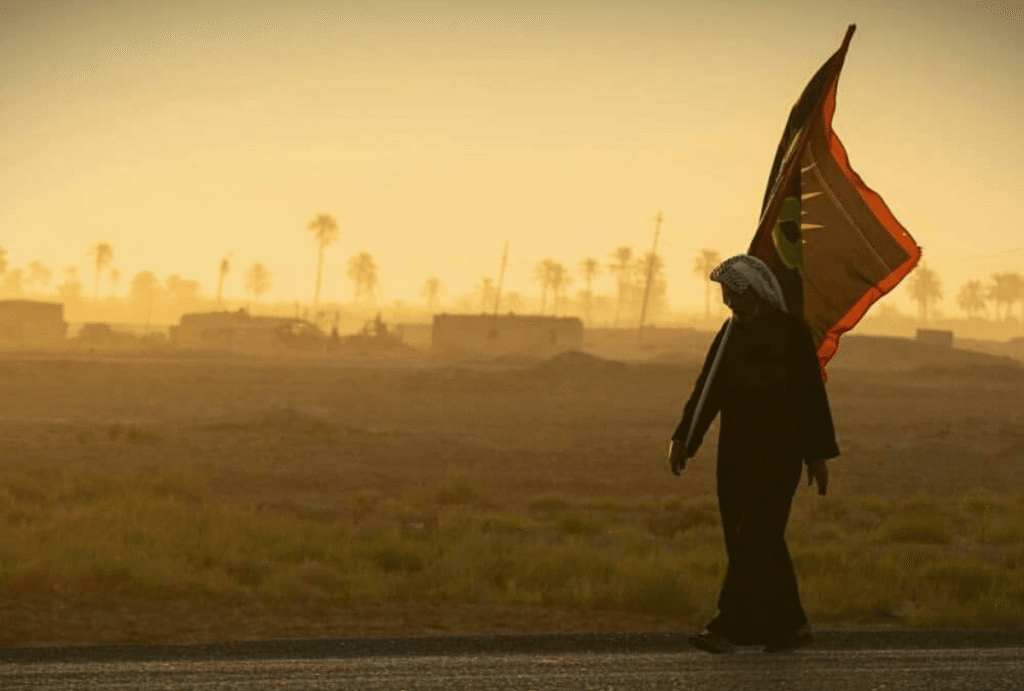
Forty days after the tragedy of Karbala, grief had not ended. The loss of Imam Hussain (as), his family, and his companions remained fresh in the hearts of those who loved them. Yet the fortieth day became more than a continuation of mourning. It became a moment of remembrance, visitation, and renewed loyalty.
This day became known as Arbaeen.
Today, millions travel towards Karbala each year to honour Aba Abdillah (as). Yet behind this global movement stands a deeply moving memory preserved within Shia tradition: the first Arbaeen, the earliest known ziyarat to Imam Hussain (as), and the remembrance of the Ahlulbayt (as) returning towards Karbala.
What does Arbaeen mean?
Arbaeen literally means “the fortieth” and refers to the fortieth day after the martyrdom of Imam Hussain (as) on the 10th of Muharram.
In Islamic tradition, the fortieth day often carries significance as a time of remembrance after loss. For Shia Muslims, Arbaeen became associated with something even deeper: carrying the message of Karbala forward after the battle had ended.
The grief of Ashura was not confined to one day. Arbaeen became a declaration that the sacrifice of Imam Hussain (as) would continue to live in the hearts and actions of believers.
This meaning reflects the Quranic relationship between the Muslim community and the family of the Prophet (saww):
Love for the Ahlulbayt (as) was never meant to remain emotional alone. Arbaeen became one of the clearest public expressions of that love through remembrance, loyalty, and devotion.
The first pilgrimage to Imam Hussain (as)
Jabir, a companion of the Holy Prophet (saww), is widely remembered in Shia tradition as the first pilgrim to visit the grave of Imam Hussain (as). Some narrations describe him travelling alongside Atiyya al-Awfi to reach Karbala on the twentieth of Safar.
This visit occupies a special place in the memory of Arbaeen because it transformed mourning into movement.
Jabir is then reported to have said, “Why a loved one does not answer one who loves him?”
He answers himself by reportedly saying, “How can he answer while his cheeks are torn, his head separated from his body?”
His ziyarat became more than a visit. It became a testimony that Karbala would not disappear into history.
Did the Ahlulbayt (as) return to Karbala?
One of the most moving and discussed parts of the first Arbaeen tradition is the reported return of the Ahlulbayt (as) to Karbala.
After Karbala, the surviving family of Imam Hussain (as) were taken first to Kufa and then to Shaam. Following their release, many historical accounts describe them returning through Karbala before continuing towards Medina.
Within these narrations are scenes that generations of believers have reflected upon: Lady Zainab (sa), Imam Zain al-Abideen (as), and the family revisiting the place where their loved ones had been martyred.
For that reason, it is responsible to present this carefully.
The return of the Ahlulbayt (as) to Karbala on the first Arbaeen remains a deeply loved and meaningful tradition within Shia memory, while historians continue to discuss the exact historical details.
Regardless of chronology, the spiritual message remains powerful: Karbala was not abandoned.
From grief to loyalty: What the first Arbaeen teaches us
The first Arbaeen represents something remarkable.
Ashura showed sacrifice.
Arbaeen showed continuation.
The battle had ended, but the message remained alive through remembrance, ziyarat, and carrying forward the values Imam Hussain (as) stood for.
The earliest visitors did not arrive with power, wealth, or recognition. They arrived with loyalty.
This transformation from grief into action remains one of Arbaeen’s defining lessons today. Mourning becomes service. Love becomes movement. Memory becomes responsibility.
Millions who gather every year are not recreating history. They are participating in a tradition rooted in remembrance and renewed commitment.
Following the example of the Ahlulbayt (as)
Throughout Shia tradition, loyalty to Imam Hussain (as) is not understood as passive attachment.
The Ahlulbayt (as) repeatedly preserved the message of Karbala through speech, remembrance, and witness.
Imam Zain al-Abideen (as), despite surviving immense suffering after Karbala, continued to keep the memory of Imam Hussain (as) alive through teaching and devotion.
Lady Zainab (sa) transformed tragedy into testimony. Her words ensured that Karbala would remain known long after the battlefield fell silent.
The first Arbaeen reflects this same principle.
To remember Aba Abdillah (as) is to continue his mission of truth, justice, and service to others.
That spirit still appears today in acts of hospitality, support for pilgrims, service to communities, and giving done for the sake of Allah (swt).
Arbaeen today: A living journey
What began with remembrance became a movement.
Today, Arbaeen brings together millions of people from across the world who travel to Karbala in devotion to Imam Hussain (as).
Many walk long distances.
Many serve food and water.
Many support pilgrims they may never meet.
This spirit reflects one of the lasting legacies of the first Arbaeen: devotion expressed through service.
Every act done sincerely becomes part of a tradition that stretches back to the earliest visitors of Karbala.
Let your giving walk beside them
The first Arbaeen reminds us that Karbala did not end on Ashura.
Through remembrance, ziyarat, and loyalty, its message continued.
From the reported return of the Ahlulbayt (as) to the visit of Jabir ibn Abdallah al-Ansari, Arbaeen became the moment when grief turned into movement.
Today, millions journey towards Imam Hussain (as).
Support the people and communities serving this extraordinary movement.
Let your giving walk beside them.
By helping sustain acts of devotion and service, we continue a tradition rooted in remembrance and carried forward through action.
Frequently asked questions
What is the first Arbaeen?
The first Arbaeen refers to the fortieth day after the martyrdom of Imam Hussain (as). It is associated with the earliest ziyarat to his grave and, in traditions, the remembrance of the Ahlulbayt (as) returning towards Karbala.
Who was the first person to visit Imam Hussain’s (as) grave?
Jabir ibn Abdallah al-Ansari is widely remembered in traditions as the first known pilgrim to visit the grave of Aba Abdillah (as) on Arbaeen.
Did the Ahlulbayt (as) return to Karbala on Arbaeen?
Many historical accounts describe the return of the Ahlulbayt (as) to Karbala after captivity. Historians continue to discuss whether the exact timing can be established with certainty.
Why is Arbaeen important?
Arbaeen represents remembrance, loyalty, and the continuation of Imam Hussain’s (as) message. It transformed mourning into ziyarat and remains one of the most significant devotional occasions in Shia Islam.
Why do people walk to Karbala for Arbaeen?
Walking to Karbala is understood as an act of devotion, remembrance, and solidarity with Imam Hussain’s (as) sacrifice and message.
More from blog
Bridging the Digital Divide Through Education
Discover how education and technology can help bridge the digital divide and create equal learning opportunities. Support children with the tools for…
Can Sadaqah Be More Than Money?
Sadaqah isn't only about giving money. Discover how your time, kindness, knowledge and actions can become acts of charity in Islam with…
The Future Starts with Education
Invest in education and help vulnerable children build skills, confidence and opportunity. Support The Zahra Trust’s Back to School appeal today.