
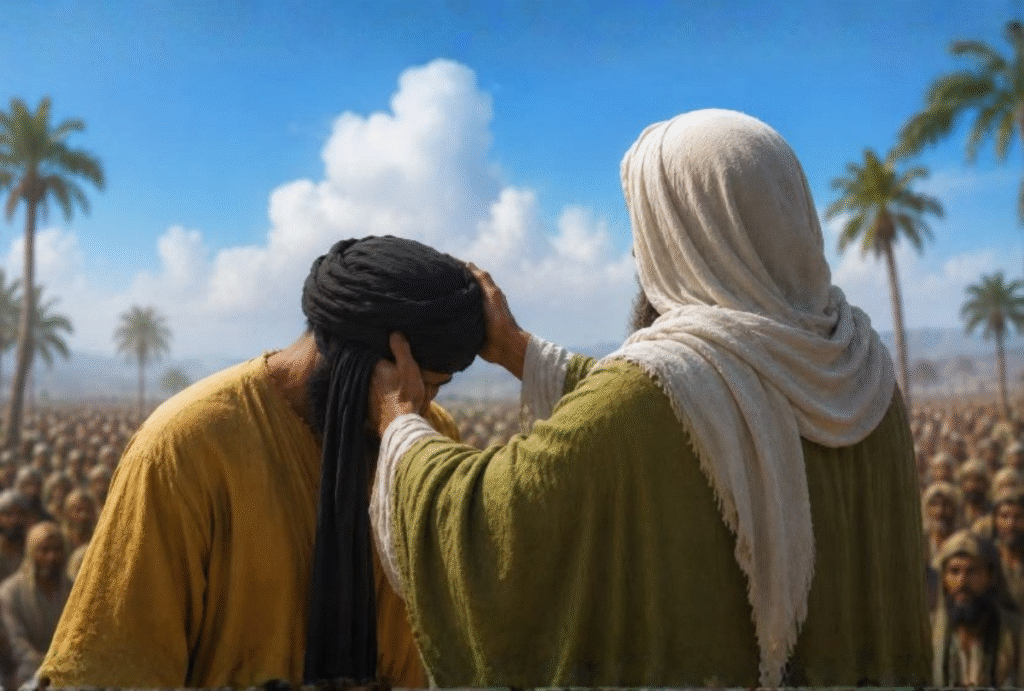
The events of Ghadeer and Karbala are deeply connected in Shia thought.
Ghadeer marked the public declaration of divinely guided leadership after the Prophet (saww), while Karbala revealed who remained truly faithful to that truth.
Together, they form a single spiritual narrative.
One established guidance, and the other tested it.
The Declaration at Ghadeer
At Ghadeer Khumm, the Prophet (saww) delivered a clear and public message to the believers:
“O people, of whoever I am the master, this Ali (as) also is his master. O Allah (swt), befriend one who befriends him, and hate one who hates him. Help one who helps him, and forsake one who forsakes him.”
Al-Amali of Shaykh Mufid, a.7, h.2
This moment represents the formal declaration of Imam Ali’s (as) wilayah, establishing a divinely guided leadership after the Prophet (saww).
Ghadeer was not symbolic alone.
It was a defining moment that set the direction for the future of faith and leadership.
A Covenant was Made
Ghadeer was also a covenant between the Prophet (saww) and the believers, rooted in obedience, responsibility, and trust.
Allah (swt) revealed:
“Today I have perfected your religion for you, I have completed My blessing (of guidance) upon you, and I have approved Islam as a religion for you.”
Surah Al-Ma’idah, Ayah 3
This verse is understood as marking the completion of divine guidance through the establishment of wilayah.
The message was clear.
Faith was no longer only about belief, but also about allegiance and commitment to divinely guided leadership.
Then Came Karbala
Decades later, Karbala became the moment that tested that covenant in the most severe way.
Imam Hussain (as) declared his mission with clarity:
“I did not march out exultingly, nor recklessly, nor seeking to make corruption in the land, nor to oppress anyone. Rather, I marched out seeking to reform my grandfather’s (saww) nation. I desire to enjoin what is right and to forbid what is wrong and to follow the sunnah of my grandfather (saww) and of my father Ali ibn Abi Talib (as).”
Maqtal al-Hussain
Karbala was no longer about declaration.
It was about sacrifice, resistance, and truth under pressure.
The Loyalty was Proven
The companions of Imam Hussain (as) demonstrated what true commitment looks like.
They stood with him despite fear, isolation, and certainty of death.
Their loyalty showed that the message of Ghadeer was not only acknowledged, but lived.
This loyalty reflects the spirit praised by Imam Hussain (as) on the eve of Ashura:
“I know no companions more worthy, nor better, than mine, nor any members of a family more joining of the ties of kinship than my Ahlulbayt (as); so, may Allah (swt) reward all of you on my behalf.”
Maqtal al-Hussain
Karbala exposed the difference between spoken allegiance and lived faith.
The Test Continues
The message of Ghadeer did not end in history, and neither did the lessons of Karbala.
Every generation faces moments where belief must become action.
Loyalty to the Ahlulbayt (as) is reflected in choices, values, and courage under pressure.
Ghadeer was the declaration. Karbala was the test.
Together, they remind believers that faith is not only acknowledged but proven through action, sacrifice, and sincerity.
Eid al Ghadeer is a day of loyalty, unity, and responsibility.
Loyalty is not only spoken, it is lived.
Celebrate with giving that honours the wilayah, by standing with vulnerable families and restoring what hardship has taken away.
Turn love of the Ahlulbayt (as) into visible care for people.
Give in honour of Ghadeer and let your loyalty be felt.
Frequently Asked Questions
Ghadeer is seen as the moment the Prophet (saww) publicly appointed Imam Ali (as) as his divinely guided successor.
Karbala is viewed as the historical test that revealed who remained loyal to the declaration made at Ghadeer.
Wilayah refers to divinely guided authority and leadership beginning with Imam Ali (as).
It tested whether believers would remain loyal to truth even under extreme pressure and sacrifice.
It teaches the importance of recognising and remaining committed to divinely guided leadership.
By living with sincerity, standing for justice, and aligning actions with the teachings of the Ahlulbayt (as).
More from blog
Bridging the Digital Divide Through Education
Discover how education and technology can help bridge the digital divide and create equal learning opportunities. Support children with the tools for…
Can Sadaqah Be More Than Money?
Sadaqah isn't only about giving money. Discover how your time, kindness, knowledge and actions can become acts of charity in Islam with…
The Future Starts with Education
Invest in education and help vulnerable children build skills, confidence and opportunity. Support The Zahra Trust’s Back to School appeal today.