
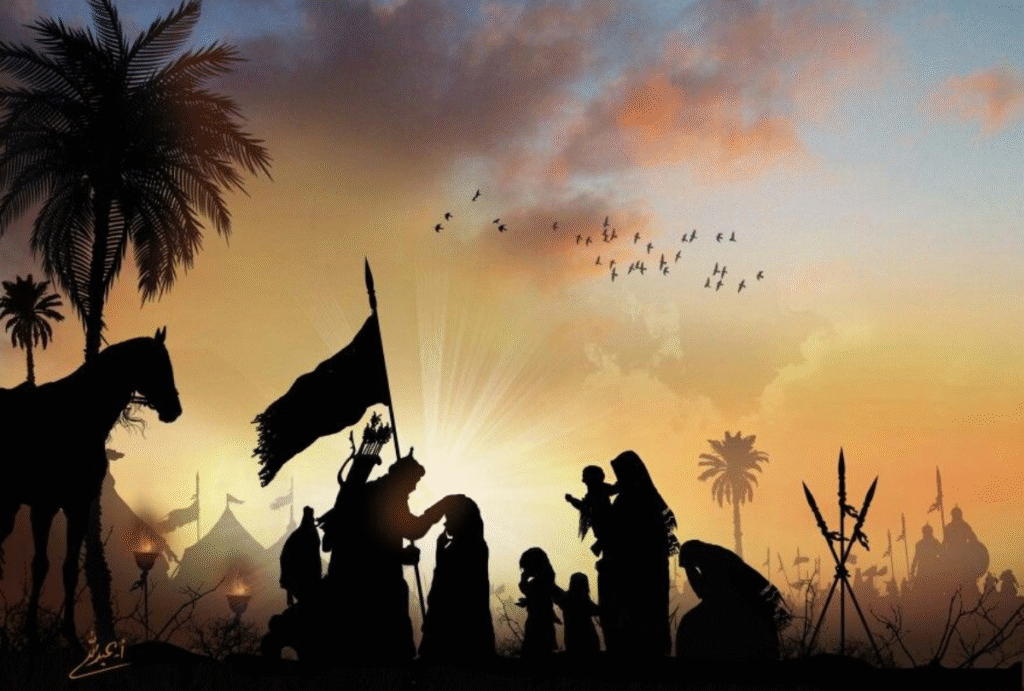
Karbala is not just a moment in history.
It is a living memory carried in the hearts of believers across generations.
It represents sacrifice, loyalty, and standing firm upon truth even when everything else is taken away.
In the year 680 CE (61 AH), Imam Hussain (as), the grandson of Prophet Muhammad (saww), stood against injustice and refused to accept tyranny.
His stand was not for power, but for truth and the preservation of faith.
What followed in Karbala became one of the most powerful moral events in Islamic history.
The Quran reminds us of the ultimate return of the righteous soul:
“O the peaceful soul! Return unto your Lord while you are well pleased (with Him) and well-pleasing (to Him), and enter among My servants, and enter My Paradise!”
Surah Al-Fajr, Ayahs 27-30
These verses are often reflected upon in relation to those who gave everything for the sake of Allah (swt), including Aba Abdillah (as) and the martyrs of Karbala.
The Stand of Imam Hussain (as): Sacrifice for Truth
Imam Hussain (as) knew the cost of his journey to Karbala.
He was aware that he would be vastly outnumbered, yet he chose not to submit to Yazid’s (la) rule because it represented oppression and corruption.
His sacrifice was not impulsive.
It was a conscious decision rooted in principle and faith.
He stood firm so that truth would not be replaced by injustice, even if it meant facing martyrdom.
The Prophet (saww) also foretold the deep emotional connection believers would always feel for this sacrifice:
“Surely, there exists in the hearts of the believers, with respect to the martyrdom of Hussain (as), a heat that never subsides.”
Mustadrak al-Wasail, v.10, p.318
This is why Karbala continues to move hearts even today.
Loyalty of the Companions
One of the most powerful lessons of Karbala is the loyalty of those who stood with Imam Hussain (as).
They knew the reality of the battlefield, yet they chose faith over fear.
Their loyalty was not blind attachment.
It was loyalty to truth itself.
Imam Hussain (as) is reported to have said:
“I know no companions more worthy, nor better, than mine, nor any members of a family more joining of the ties of kinship than my Ahlulbayt (as); so, may Allah (swt) reward all of you on my behalf.”
Maqtal al-Hussain
This statement reflects deep recognition of their sincerity, unity, and unwavering devotion.
Among them, Hazrat Abbas (as) stands as one of the strongest symbols of loyalty in Karbala.
He is remembered for his attempt to bring water to the thirsty camp.
Despite intense thirst, he did not drink, choosing instead to fulfil his duty to Imam Hussain (as).
His sacrifice reflects loyalty that rises above personal survival and becomes a form of devotion.
The Aftermath: When Silence Became Speech
The message of Karbala did not end on the battlefield.
It continued through the survivors who carried the truth into the courts of power.
Sayyida Zainab (sa) became the voice of Karbala.
In Kufa and Damascus, she spoke with courage and clarity, refusing to let injustice be hidden or rewritten.
Her words transformed grief into testimony.
Imam Ali ibn Hussain (as), known as Imam Sajjad (as), also endured immense suffering.
He carried the responsibility of preserving the spiritual leadership of the Ahlulbayt (as) while witnessing unimaginable tragedy.
Imam al-Sadiq (as) is reported to have said:
“As for Ali ibn Hussain (as), he cried over Hussain (as) for twenty years (after the tragedy of Karbala); never would any food be placed before him except that he would begin to weep.”
Bihar al-Anwar, v.46
This reflects how deeply the sorrow and memory of Karbala remained alive within the household of the Prophet (saww).
Core Lessons from Karbala
Karbala teaches timeless lessons that continue to guide believers today:
- Standing firm for truth, even when alone
- Rejecting oppression in all its forms
- Placing principle above personal comfort
- Understanding loyalty as devotion to righteousness
- Preserving faith through patience and endurance
It shows that victory is not always measured in survival, but in remaining faithful to what is right.
A Legacy That Never Fades
Karbala is not only a historical tragedy; it is a timeless lesson for humanity.
It reminds us that truth may be tested, but it can never be erased.
From Imam Hussain (as) to his companions, from Sayyida Zainab (sa) to Imam Sajjad (as), every figure in Karbala reflects a different form of sacrifice and loyalty.
Their story continues to live, not as a memory of loss, but as a guide for those seeking justice, faith, and purpose in their own lives.
Frequently Asked Questions
Karbala is important because it represents the stand of Imam Hussain (as) against injustice, showing that truth must always be defended, even at great personal cost.
His message was to uphold justice, resist tyranny, and preserve the true values of Islam, even when faced with death.
Hazrat Abbas (as) was the brother of Imam Hussain (as) and Sayyida Zainab (sa). He is remembered for his loyalty, bravery, and refusal to abandon duty even in extreme hardship.
She became the voice of Karbala, speaking boldly in the courts of Kufa and Damascus to expose injustice and preserve the truth.
Because its message of sacrifice, loyalty, and justice continues to inspire people to stand against oppression and remain faithful to truth.
It teaches courage, patience, loyalty, and the importance of standing for justice even when it is difficult or dangerous.
More from blog
Bridging the Digital Divide Through Education
Discover how education and technology can help bridge the digital divide and create equal learning opportunities. Support children with the tools for…
Can Sadaqah Be More Than Money?
Sadaqah isn't only about giving money. Discover how your time, kindness, knowledge and actions can become acts of charity in Islam with…
The Future Starts with Education
Invest in education and help vulnerable children build skills, confidence and opportunity. Support The Zahra Trust’s Back to School appeal today.