
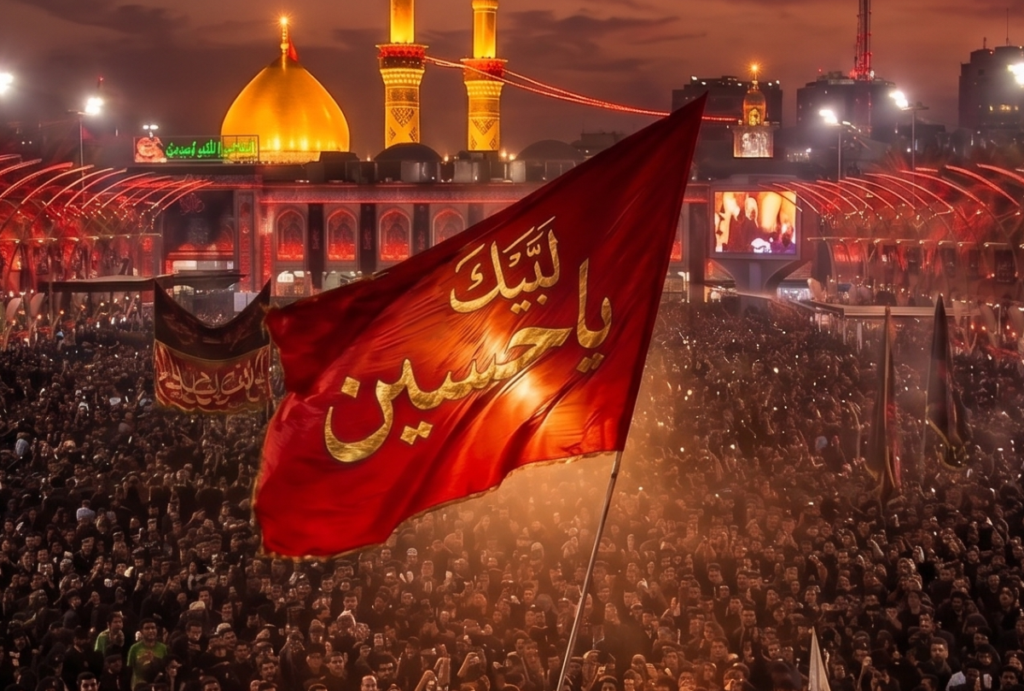
To understand what “Labbayk Ya Hussain” means today, we must move beyond translation into meaning. These words are not only recited in Muharram gatherings. They represent a response, a readiness, and a commitment.
“Labbayk Ya Hussain” means “Here I am for Hussain.” It is a declaration that the message of Imam Hussain (as) is not confined to history. It continues as a living call that asks believers how they will respond to truth, injustice, and suffering today.
It is less about language and more about action, identity, and loyalty.
The core meaning of Labbayk Ya Hussain
The word labbayk means “here I am” or “at your service.” It is traditionally used as a response to a call, showing readiness and devotion.
When connected to Imam Hussain (as), it becomes a statement of allegiance to his values: truth, sacrifice, and resistance to oppression.
In this sense, “Labbayk Ya Hussain” is not about invoking Imam Hussain (as) independently. It is about affirming commitment to his path, which represents the path of justice and faith.
This is why the phrase is so widely used during Muharram. It captures both grief and responsibility in a single expression.
A Quranic foundation: Standing with justice
The spirit of Karbala is closely aligned with the Quranic call to uphold justice and goodness.
Allah (swt) says:
This verse highlights a responsibility placed on believers to actively promote good and resist wrongdoing. It is not passive belief, but active engagement with the world.
In this way, the message of Imam Hussain (as) in Karbala reflects this Quranic principle. His stand was a living example of commanding right and standing against injustice, even in the most difficult circumstances.
Loyalty through the example of the martyrs of Karbala
Imam Hussain (as) is remembered not only for his sacrifice but also for his unwavering commitment to truth under extreme pressure.
His stand in Karbala reflects the broader teachings of the Ahlulbayt (as), who consistently emphasised justice, compassion, and moral integrity.
Across Islamic historical and devotional tradition, Karbala is remembered as a defining moment where faith was expressed through sacrifice, moral courage, and resistance to oppression.
This example shows that loyalty to Imam Hussain (as) today is not symbolic alone. It requires action. It requires compassion. It requires standing with those who are vulnerable.
The emotional depth of remembering Hussain (as)
The Prophet (saww) is reported to have said:
Mustadrak al Wasail v.10, p.318
This narration reflects the deep emotional connection believers continue to feel towards Imam Hussain (as). It explains why his memory remains so powerful across generations.
This emotional response is not meant to end in grief alone. It becomes a force that inspires continued commitment to his values.
What “Labbayk Ya Hussain” means in today’s world
Today, the meaning of “Labbayk Ya Hussain” extends into lived experience.
It means:
- Standing with justice where injustice exists
- Supporting those in need
- Keeping the values of Karbala alive through action
- Transforming grief into service
In this sense, remembrance becomes responsibility. The message of Imam Hussain (as) moves from memory into practice.
Turning remembrance into responsibility
To answer the question, “What does ‘Labbayk Ya Hussain’ mean today?” is to recognise that it is not only a phrase of mourning. It is a call to action.
Imam Hussain (as) stood for truth, justice, and dignity in the face of oppression. His message challenges believers today to carry those same values into the world around them.
This is why remembrance cannot remain only emotional. It must become practical, lived, and visible through service to others.
This Muharram, honour Imam Hussain (as) by turning grief into mercy. Support Muharram Giving and Food Aid through The Zahra Trust. In doing so, remembrance becomes action, and love becomes service to those in need.
FAQs
What does “Labbayk Ya Hussain” mean in simple terms?
It means “Here I am for Hussain” and expresses readiness to follow his values of truth, justice, and sacrifice.
Is “Labbayk Ya Hussain” only a mourning slogan?
No. It is also a declaration of action, encouraging believers to live by Imam Hussain’s (as) principles.
How is “Labbayk Ya Hussain” connected to Karbala?
It reflects loyalty to Imam Hussain (as) and his stand against injustice during the tragedy of Karbala.
Can saying “Labbayk Ya Hussain” include charity?
Yes. Many believers express it through acts of charity such as volunteering and donating.
What does Islam say about standing up for justice?
The Quran encourages believers to promote good and prevent wrongdoing, as stated in verse 104 of Surah Aal-Imran.
Why do believers feel emotional when remembering Imam Hussain (as)?
For many believers, remembering Imam Hussain (as) is not only about reflecting on a historical event. Karbala represents sacrifice, faith, moral courage, and standing for truth in the face of injustice.
More from blog

Bridging the Digital Divide Through Education
Discover how education and technology can help bridge the digital divide and create equal learning opportunities. Support children with the tools for…
Can Sadaqah Be More Than Money?
Sadaqah isn't only about giving money. Discover how your time, kindness, knowledge and actions can become acts of charity in Islam with…
The Future Starts with Education
Invest in education and help vulnerable children build skills, confidence and opportunity. Support The Zahra Trust’s Back to School appeal today.