
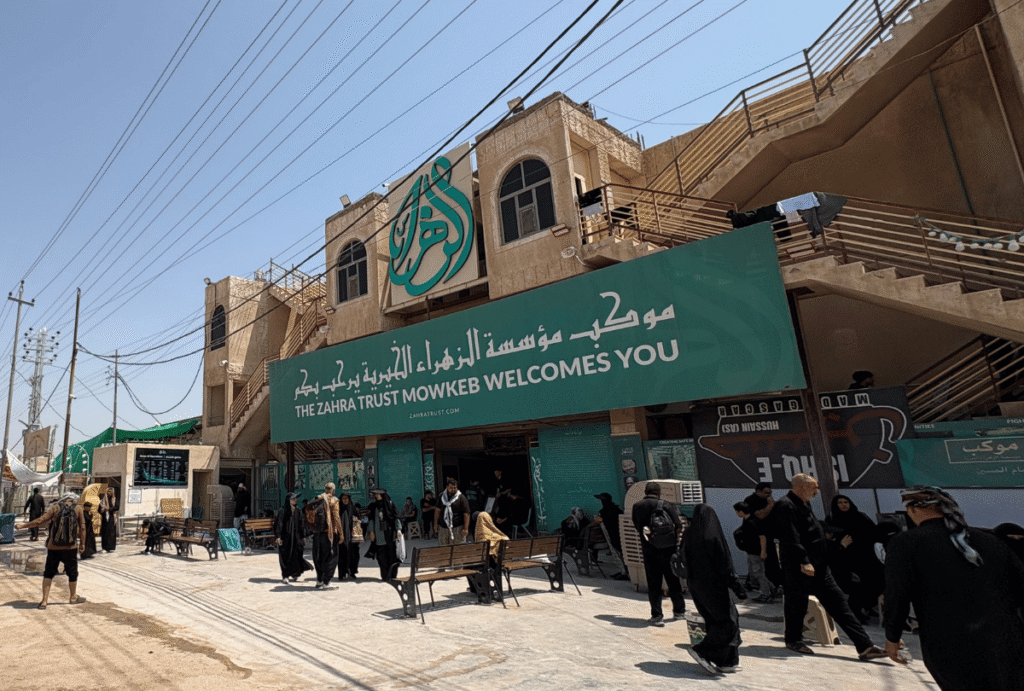
Mowkebs, or mawakeb, are one of the most powerful expressions of devotion within the Arbaeen pilgrimage to Karbala. At their core, they are volunteer-run service stations that line the route between Najaf and Karbala, offering pilgrims food, drink, shelter, medical care, and rest.
But to describe mowkebs only as logistical stops would miss their deeper meaning. They are living symbols of Hussaini hospitality, where service becomes worship, and every act of generosity is tied to remembrance of Imam Hussain (as).
As pilgrims walk for days towards Karbala, mowkebs transform the journey into something supported entirely by collective giving. Families, communities, and organisations come together to ensure that no pilgrim walks alone or unsupported.
The tradition reflects the meaning of Arbaeen itself, which is not only mourning, but movement, unity, and devotion expressed through action.
The meaning and spiritual roots of mowkebs
In the Arbaeen context, mowkebs represent a spiritual economy built on generosity. Everything offered is donated, and everything given is considered an act of devotion.
This aligns deeply with Quranic teachings on spending in the way of Allah (swt):
The verse captures the spirit of mowkebs perfectly, where giving is not limited by time or circumstance, but becomes a constant expression of faith.
Another verse reinforces this spiritual multiplication of charity:
Within mowkeb culture, this belief in divine reward fuels an extraordinary level of generosity.
A history of revival and resilience
For many years, particularly under the rule of Saddam Hussein, public mourning for Imam Hussain (as) and large-scale Arbaeen gatherings were heavily restricted. During this period, both the walk and the establishment of mowkebs were effectively suppressed.
After 2003, the tradition re-emerged rapidly. What followed was not just a revival, but a transformation into one of the largest volunteer-based service movements in the world.
Today, millions of pilgrims walk the route to Karbala, supported by hundreds of mowkebs operating day and night.
Hussaini hospitality in action
At the heart of mowkeb culture is a simple principle: no guest of Imam Hussain (as) should be left without care.
Services commonly include:
Fresh meals and drinks
Rest areas and sleeping spaces
First aid and medical support
Foot care and physical assistance
Wheelchairs and mobility support
Religious recitations and mourning gatherings
This is not charity in the conventional sense. It is a shared act of devotion, where serving others is seen as serving the cause of Imam Hussain (as) himself.
This meaning is echoed in the teachings of Prophet Muhammad (saww):
“No sooner does a Muslim serve a group of Muslims than Allah (swt) will give him servants equal in number (to the group) in Paradise.” (Al-Kafi, v.2, p.307, n.1)
Service becomes something far greater than physical assistance. It becomes a pathway to spiritual reward.
Imam Ali (as) also emphasised the spiritual depth of feeding others:
“The nourishment of the body is food whilst the nourishment of the soul is feeding others.”(Mishkat al-Anwar, n.325)
Within mowkebs, both meanings come together in lived form.
Devotion through the example of the Ahlulbayt (as)
One of the most striking features of mowkebs is the sense of equality they create. Rich and poor, young and old, local and international pilgrims all receive the same hospitality.
This shared experience reflects the values of Karbala itself, where dignity is not defined by status but by sincerity and devotion.
Imam al-Sadiq (as) is reported to have said:
“A man who fulfils one need of his believing brother’s, Allah (swt) will fulfil one hundred thousand needs of his on the Day of Resurrection.” (Bihar al-Anwar, v.74, p.89, n.90)
In mowkeb culture, fulfilling needs is not occasional. It is continuous, collective, and deeply embedded in community identity.
The Zahra Trust Mowkeb
While mowkebs remain most visible across Iraq during Arbaeen, the tradition has grown far beyond geographical borders. Across the world, communities continue to carry forward this culture of service, reflecting the global connection people feel to Imam Hussain (as) and the values he stood for.
At The Zahra Trust, serving the zuwar has become one of the ways we take part in this living tradition.
Through this mowkeb, we work to help provide:
Hot meals and clean drinking water
First aid and practical support
Shaded rest areas for recovery
Care and assistance for pilgrims from different backgrounds and languages
For us, a mowkeb is more than a service station. It is an opportunity to honour Imam Hussain (as) through hospitality, compassion, and care.
Each year, witnessing people come together to serve reminds us that Arbaeen is not only about reaching Karbala. It is also about carrying forward the spirit of giving that defines the journey itself.
Why mowkebs matter today
In a modern world often defined by individualism, mowkebs stand as a reminder of collective responsibility.
The nourishment of the soul is found in serving others, and mowkebs turn this principle into reality on a massive scale.
Serving the pilgrims of Hussain (as)
Mowkebs are more than a tradition. They are a living expression of faith, generosity, and devotion that transforms the Arbaeen journey into a shared act of worship.
From food and shelter to care and companionship, every mowkeb reflects a simple truth: serving pilgrims is serving the path of Imam Hussain (as).
As millions continue to walk towards Karbala, this spirit of service remains alive through communities that give without expectation and support without limit.
Serve the path of Hussain (as).
Through mowkeb support and Arbaeen giving with The Zahra Trust, your contribution helps sustain these stations of mercy, ensuring that no pilgrim walks alone on the road to Karbala.
Frequently asked questions
What is a mowkeb in the Arbaeen pilgrimage?
A mowkeb is a volunteer-run service station that provides food, shelter, and support to pilgrims walking from Najaf to Karbala during Arbaeen.
Who runs mowkebs?
Mowkebs are run by volunteers, local communities, and charitable organisations who donate time, money, and resources.
Are mowkebs only found in Iraq?
While most mowkebs are in Iraq along the pilgrimage route, similar initiatives now exist in other countries during Arbaeen.
What services do mowkebs provide?
They provide food, water, accommodation, medical care, foot support, and spiritual gatherings.
Why are mowkebs important?
They represent the Hussaini hospitality and the values of service, sacrifice, and devotion to Imam Hussain (as).
Can international visitors access mowkeb services?
Yes, mowkebs welcome pilgrims from all backgrounds and nationalities during Arbaeen.
More from blog

Bridging the Digital Divide Through Education
Discover how education and technology can help bridge the digital divide and create equal learning opportunities. Support children with the tools for…
Can Sadaqah Be More Than Money?
Sadaqah isn't only about giving money. Discover how your time, kindness, knowledge and actions can become acts of charity in Islam with…
The Future Starts with Education
Invest in education and help vulnerable children build skills, confidence and opportunity. Support The Zahra Trust’s Back to School appeal today.