
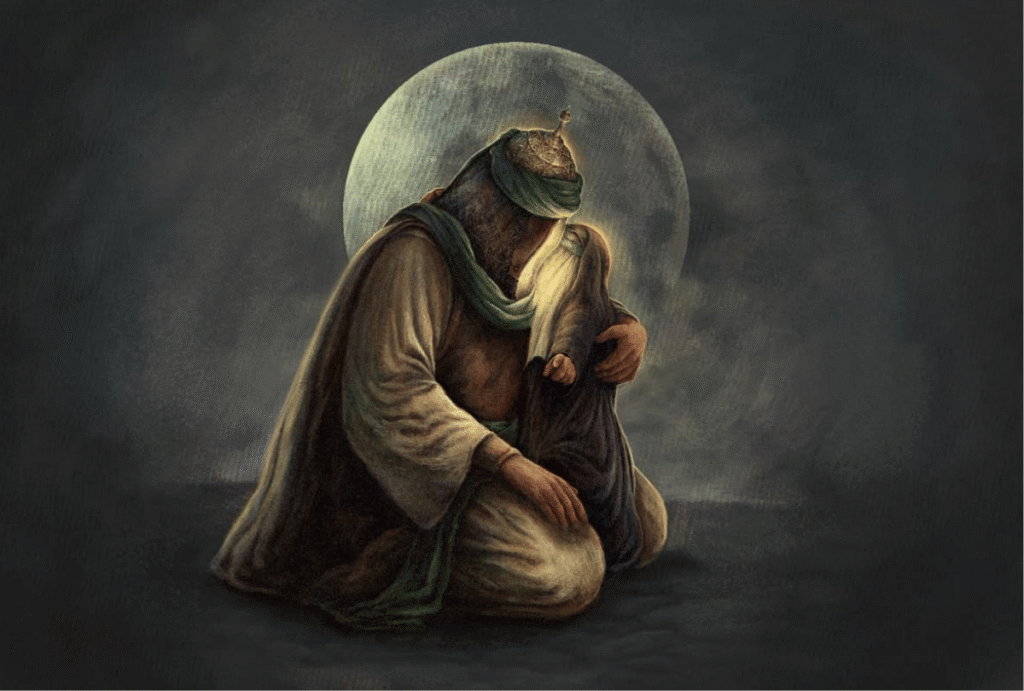
The legacy of Sayyida Sakina (sa) is not only remembered within the historical tragedy of Karbala and its aftermath in the journey to Shaam, but also lives on as a universal symbol of innocence affected by injustice. Her story represents every child who experiences loss, displacement, fear, or neglect.
In Islamic remembrance, particularly within the teachings inspired by the Ahlulbayt (as), children are seen as a trust from Allah (swt). The suffering of Sayyida Sakina (sa), the young daughter of Imam Hussain (as), reminds us that protecting children is not optional but a moral responsibility. Her legacy continues to speak across generations, especially in times of reflection during Muharram and Safar.
The innocence at the heart of Karbala
The tragedy of Karbala is often understood through sacrifice, resistance, and truth against oppression. Within this wider narrative, Sayyida Sakina (sa) represents the purest form of innocence caught in the midst of injustice.
She is remembered as deeply attached to her father, Imam Hussain (as), and as a child whose heart was shaped by love, prayer, and connection to Allah (swt). Her experience in captivity after Karbala reflects the broader suffering endured by the Ahlulbayt (as).
Her story is not only a historical memory. It has become a moral lens through which we view the suffering of children everywhere, especially those affected by war, poverty, and displacement.
A Quranic reminder about protecting the vulnerable
Islam places strong emphasis on the dignity and care of orphans and vulnerable individuals. This principle is central when reflecting on the legacy of Sayyida Sakina (sa), as it calls us to protect those who cannot protect themselves.
Allah (swt) says in the Quran: “Therefore, as for the orphan, do not humiliate (him).” (93:9)
This verse is a direct reminder that honour and dignity must be preserved for every orphan and vulnerable child. The suffering associated with Karbala strengthens this message, urging believers to ensure that no child is ever subjected to humiliation, neglect, or harm.
When we reflect on Sayyida Sakina (sa), this verse becomes more than guidance. It becomes a responsibility in action.
Love within the household of the Ahlulbayt (as)
The emotional depth of Sayyida Sakina (sa)’s place within the family of Imam Hussain (as) is also reflected in narrations that highlight love and tenderness within their household.
This narration reflects the warmth, affection, and humanity within the family of the Ahlulbayt (as). It also deepens our understanding of what was lost in Karbala and its aftermath. The separation and grief experienced by Sayyida Sakina (sa) becomes even more profound when viewed through this lens of love and attachment.
Her legacy is therefore not only about sorrow, but also about love that was tested through unimaginable hardship.
Sakina (sa) as a symbol for every vulnerable child
The legacy of Sayyida Sakina (as) extends far beyond historical remembrance. It becomes a symbol for every child who suffers silently today.
Across the world, children face:
Loss of parents
Forced displacement
Hunger and poverty
Emotional trauma
Lack of safety and education
In this way, Sayyida Sakina (sa) becomes a reflection of every vulnerable child whose voice is unheard. Her story transforms grief into awareness, and awareness into responsibility.
Her innocence challenges us to see suffering not as distant or abstract, but as something that demands compassion and action.
Lessons from the Ahlulbayt (as): Compassion in action
The Ahlulbayt (as) consistently taught mercy, justice, and care for the vulnerable. The events of Karbala and its aftermath highlight not only sacrifice, but also the importance of standing for dignity.
The teachings of the Ahlulbayt (as) remind believers that compassion is not limited to emotion. It must be expressed through action, especially towards orphans and children in need.
Sayyida Sakina (sa) stands as a living reminder of this responsibility. Her memory calls on communities to ensure that no child is left unsupported, unheard, or unsafe.
A living responsibility in today’s world
The message of Sayyida Sakina’s (sa) legacy is especially relevant in today’s world, where crises continue to affect millions of children.
Her story urges us to ask:
Are we protecting the vulnerable in our communities?
Are we supporting children who have lost parental care?
Are we responding to suffering with meaningful action?
In Muharram and Safar, as believers reflect on the aftermath of Karbala, these questions become even more significant. Reflection is not meant to remain emotional alone. It must lead to responsibility.
Continuing her legacy beyond Muharram and Safar
The impact of Karbala does not end with remembrance. The legacy of Sayyida Sakina (sa) invites us to transform reflection into lasting action.
At The Zahra Trust, supporting orphan care means continuing the message of compassion taught by the Ahlulbayt (as). It is a way to ensure that remembrance becomes responsibility.
Safar is a time of reflection, but reflection must lead to impact. Every act of care for an orphan is a continuation of mercy, dignity, and love inspired by Imam Hussain (as) and his family.
Give beyond the season. Build a lasting legacy through support for orphans. A legacy that lives on is one that continues to serve the vulnerable long after words are spoken.
Frequently asked questions
Who was Sayyida Sakina (sa)?
Sayyida Sakina (sa) was the young daughter of Imam Hussain (as), remembered for her innocence, devotion, and deep emotional connection to her family during and after the tragedy of Karbala.
Why is Sayyida Sakina (sa) important in Islamic history?
She represents the suffering of innocent children in Karbala and has become a lasting symbol of vulnerability, dignity, and resilience in the face of injustice.
What does the Quran say about caring for orphans?
The Quran instructs believers in verse 9 of Surah ad-Duha, “Therefore, as for the orphan, do not humiliate (him)”, emphasising dignity, protection, and respect for vulnerable children.
How is Sayyida Sakina (sa) connected to orphan care today?
Her story reflects the struggles of orphaned and vulnerable children, encouraging believers to actively support and protect those in need.
What can we learn from the legacy of Sayyida Sakina (sa)?
We learn the importance of compassion, justice, and standing with those who suffer, especially children who cannot defend themselves.
How can we honour her memory in modern times?
We can honour her legacy by supporting orphan care, helping vulnerable children, and ensuring dignity and safety for those in need.
More from blog
Bridging the Digital Divide Through Education
Discover how education and technology can help bridge the digital divide and create equal learning opportunities. Support children with the tools for…
Can Sadaqah Be More Than Money?
Sadaqah isn't only about giving money. Discover how your time, kindness, knowledge and actions can become acts of charity in Islam with…
The Future Starts with Education
Invest in education and help vulnerable children build skills, confidence and opportunity. Support The Zahra Trust’s Back to School appeal today.