
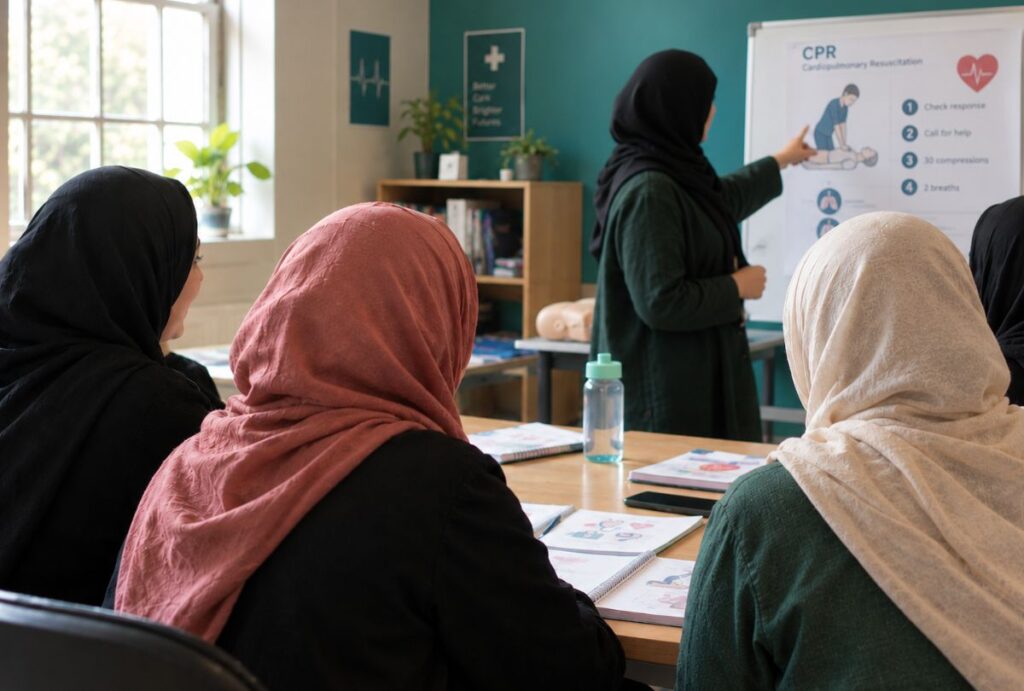
Skills training can be much more than a lesson in a classroom. For someone facing financial hardship, learning a practical, marketable skill can create a pathway towards income, greater stability and a more secure future for their family.
When a parent, particularly a woman supporting children alone, gains the ability to earn a lawful livelihood, the impact can reach far beyond the individual. Income can help provide food, education, healthcare and other essentials, while a new skill can also be passed on to children and other members of the community.
“…Allah (swt) does not change the (positive) condition of any people unless they change (the attitude) that is within them.” (13:11)
For families experiencing hardship, skills training can be one part of that process of change. It gives people practical tools they can use to create opportunities for themselves and those who depend on them.
From Learning a Skill to Strengthening a Family
Vocational education is most meaningful when learning can be applied to everyday life.
A person may learn tailoring, food processing, agriculture, electrical work, business management or another practical trade. With the right support, that knowledge can become employment, self-employment or a small home-based enterprise.
The pathway can be simple:
Skills → income → household stability → greater opportunity.
Evidence from skills and livelihood programmes illustrates how these effects can extend into the household. In Pakistan, an evaluation of the Skills for Market programme found that women who completed rural tailoring training were more likely to engage in tailoring-related work. Their households also recorded 11.6% higher income than those of women who did not receive the training. Where training was combined with market-linkage support, participating households recorded higher consumption, alongside improvements in some child nutrition indicators.
The findings highlight an important point. Training has greater potential to create sustainable change when people have an opportunity to use what they have learned.
Dhuha’s Journey Towards a New Livelihood
In southern Najaf, Iraq, 34-year-old Dhuha is finding a new way to support her family.
Dhuha is a widow and the mother of two daughters. After her husband’s death six years ago, she became the sole provider for her family. Without formal employment and with limited family support, she relied on irregular assistance to meet their needs.
The cost of living made an already difficult situation harder. Dhuha had to think carefully about how to pay for her daughters’ education, food, clothing and medical expenses. Securing independent housing was another source of concern.
Her government social welfare allowance covered only part of her expenses. She therefore began carefully rationing her spending, prioritising the essentials for herself and her daughters.
For Dhuha, the challenge was not simply a lack of money. She needed an opportunity to develop a skill that could become a source of income while fitting around her responsibilities at home.
Skills That Can Work Around Real-life Circumstances
In Dhul-Hijjah 2026, The Zahra Trust included Dhuha in its Economic Empowerment Programme for Widows and the Vulnerable.
She completed a 30-hour educational workshop alongside 14 widows, orphans and vulnerable women, learning how to sew the Najafi women’s abaya. She also received an abaya and sewing equipment to help her begin working from home.
This approach matters because livelihood opportunities do not exist in isolation from family responsibilities. For some women, travelling to a workplace or taking on conventional employment may not be practical. A home-based skill can provide another route towards earning an income.
Dhuha expects to sew four abayas each month, which provides her with additional income.
She also sees an opportunity beyond her own work. The sewing skill she has learned can be shared with her two daughters, potentially giving them a practical skill they can use in the future.
As Dhuha put it:
“I longed to start a business, but I had no experience. Now my dream has come true by taking a course in sewing the women’s abaya that is distinctive in our provinces, and I can also sew clothes in cooperation with my daughters.”
Her story shows how skills training can extend beyond the person who receives it. A skill can become something a family shares, develops and builds upon.
A Livelihood Can Support More Than Income
Islam places importance on seeking a lawful livelihood and working towards self-sufficiency.
The Prophet (saww) is reported to have said:
“Worship consists of ten parts, of which nine are to do with earning a lawful livelihood.” (Bihar al-Anwar, v.103, p.9, n.37)
This principle helps frame skills training in a broader way. The purpose is not simply to increase earnings. It can help a person pursue dignified, lawful work and meet the needs of their household through their own effort.
For families facing financial insecurity, even an additional source of income can help ease difficult decisions. It may contribute towards food, school costs, healthcare, housing or other essentials.
Evidence from Zambia demonstrates the potential scale of these household effects. The World Bank’s Supporting Women’s Livelihoods programme combined life and business-skills training with mentoring, a productivity grant and savings-group support. Three years after the programme, participating households recorded a 62% increase in household income, a 38% increase in overall consumption and a 35% increase in food consumption. The programme was also associated with a 30% reduction in extreme poverty and a reduction in the number of months households experienced insufficient food.
These results suggest that practical training can contribute to household resilience when it is combined with the resources and support needed to put those skills into practice.
When Skills Reach the Next Generation
The benefits of a livelihood can also reach children.
The International Labour Organization has documented examples of women whose business training helped them establish or improve small enterprises. In Ethiopia, Almaz used business training and market research to move from food retailing into butchery. Her business eventually generated average monthly revenues of approximately 15,000 Ethiopian birr, and she used the profits to send all three of her children to school.
In Uganda, women who learned to turn discarded plastic straws into saleable products also reported improvements in their ability to provide for their families. One participant, Benedicta, said that increased income helped her feed her family and send children who had previously been out of school back into education.
These examples demonstrate a powerful connection:
Skills can create income. Income can create stability. Stability can create opportunities for children.
“…A person does not deserve (anything) but what he strives for…” (53:39)
The verse speaks to the value of striving and effort. Skills training can give that effort a practical foundation, helping people develop capabilities they can use to pursue a livelihood.
Learning Needs a Pathway to Opportunity
A person can complete a course and still struggle to find customers, employment or the resources needed to begin working. That is why effective vocational education often needs to be connected to real economic opportunities.
UNICEF’s “Let Us Learn” initiative found that vocational training was particularly effective when programmes included a direct pathway into employment. In Bangladesh, 96% of graduates in one programme found employment, with many entering the businesses of the master craftspersons who trained them. At the same time, UNICEF noted that earnings remained modest where participants entered low-paid informal work.
This is why skills programmes can be strengthened through mentoring, tools, start-up support, apprenticeships, market access, financial literacy and connections with employers or customers.
For Dhuha, providing sewing equipment alongside training gives her a practical means of beginning to use the skill she has acquired.
Prophet Muhammad (saww) is reported to have said:
“Seeking a lawful livelihood is incumbent upon every Muslim man and woman.” (Jami’a al-Akhbar, p.389, n.1079)
A Skill Can Become a Legacy
Dhuha is one of 15 widows, orphans and vulnerable women who received this educational support through the programme. More broadly, more than 150 women had previously been included in The Zahra Trust’s Women’s Economic Empowerment Programme in Najaf.
Her story also shows why the impact of skills training should not always be measured by the first pay packet.
Dhuha expects to use her new skill to sew abayas from home. She can potentially share that knowledge with her daughters. Her daughters may then have a practical skill that can support them in the future.
This is where vocational education can create change beyond the classroom. A lesson can become a livelihood. A livelihood can support a household. And knowledge can be passed from one generation to the next.
Rasoolallah (saww) is reported to have said:
“The best livelihood is that which suffices.” (Bihar al-Anwar, v.77, p.168, n.4)
For families facing hardship, sufficiency can mean having enough to meet essential needs with greater dignity and less uncertainty.
Give Skills That Can Build a Future
Education should not end when a course does.
For vulnerable women and families, practical skills can open pathways towards lawful work, household stability and greater independence. When training is matched with the right equipment, mentoring and opportunities to earn, its impact can extend well beyond the person sitting in the training room.
Dhuha’s story is one example of what that change can look like. She entered a sewing workshop without the experience she needed to start a business. She left with a practical skill, equipment and a new possibility for supporting her daughters from home.
Your support can help provide vulnerable people with skills that are designed not only for today, but for the opportunities of tomorrow.
Give more than training. Give a pathway to a livelihood.
Frequently Asked Questions
What is skills training?
Skills training provides people with practical knowledge and abilities that can be used in employment, self-employment or small businesses. Depending on the programme, this may include areas such as tailoring, agriculture, food processing, technical trades or business skills.
How can skills training help families?
Skills training can help people develop a source of income, which may contribute towards essential household costs such as food, education, healthcare and housing. Its impact depends on whether participants can access suitable work, customers or markets after training.
Why is vocational education important?
Vocational education focuses on practical abilities that can be applied to real-world work. For people facing economic hardship, relevant vocational skills can provide another pathway towards earning a lawful livelihood and becoming more financially resilient.
Can skills training help women become financially independent?
It can create opportunities for women to earn through employment or self-employment. Programmes may be particularly useful when they take account of practical barriers such as mobility, household responsibilities and access to equipment or markets.
Does skills training benefit children too?
The benefits can extend to children when additional household income helps families meet expenses such as school fees, learning materials, food and healthcare. Skills can also sometimes be passed from parents to children, creating opportunities beyond the original training.
Why does skills training need support beyond the classroom?
Completing a course does not automatically lead to income. Participants may also need equipment, mentoring, financial literacy, apprenticeships, start-up support or connections to employers and markets so they can apply their new skills.
More from blog
Rebuilding Futures Through Education: Restoring Hope, Dignity and Opportunity
When a community experiences crisis, the impact reaches far beyond the immediate moment. Conflict, poverty, and displacement can interrupt a child’s education,…
From Backpack to Graduation: The Ripple Effect of Education
Discover how an education donation can help remove barriers to learning, from school essentials to meals and fees. Help a child start…
What’s Inside a Sponsored Classroom?
When you imagine a classroom, you might picture desks, books, and a teacher standing at the front of the room. But for…