
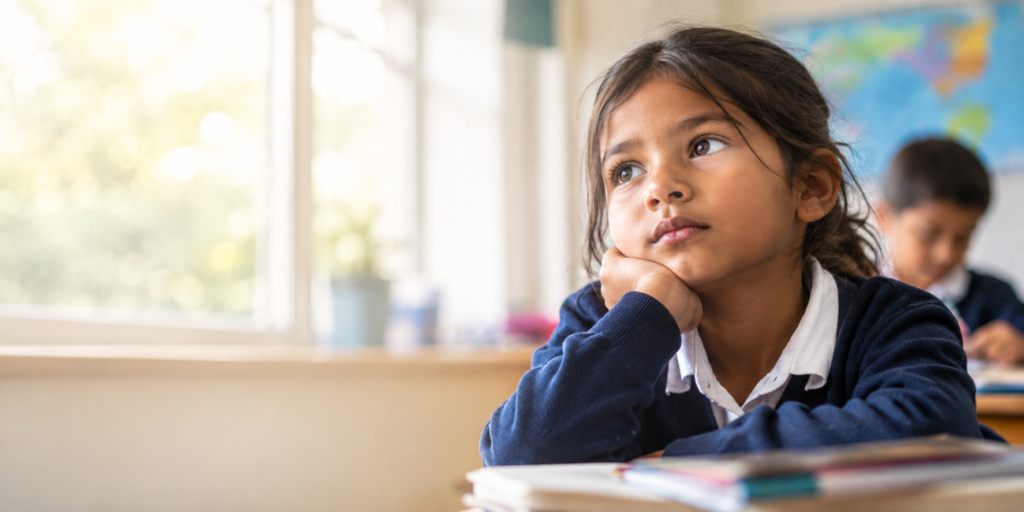
For a child, a year away from school can mean much more than missing lessons. Education builds progressively, with each stage providing knowledge and skills needed for what comes next. When that progression is interrupted, learning gaps can develop and become harder to overcome.
For some children, missing a year of school is linked to illness, displacement, conflict or other circumstances beyond their control. For others, poverty can create barriers that make regular attendance difficult. The cost of school fees, uniforms, supplies and even a daily meal can determine whether a child is able to enter the classroom.
The consequences can extend beyond the classroom. Research links prolonged or repeated absence with lower educational attainment, greater risk of leaving education early and poorer employment outcomes later in life. This makes access to consistent education an important part of protecting a child’s future.
How Missing a Year of School Can Affect Learning
School curricula are designed around progression. New concepts often depend on skills learnt in previous years, particularly in subjects such as reading, writing and mathematics.
When a child misses an extended period of education, they may return to lessons without the foundation needed to understand new material. A child who has missed important literacy or numeracy instruction, for example, may find subsequent work more challenging.
Research on school attendance has found that pupils with long-term absence can experience weaker academic performance and slower learning progress, even when previous attainment is taken into account.
The effect can therefore continue after the child returns to school. Catching up may require additional support, time and encouragement, particularly when gaps have accumulated across several areas of learning.
Why One Year Can Have Lasting Consequences
It can be tempting to think of one missed year as something a child can simply make up later. In reality, the impact depends on what was missed, when the interruption occurred and what support is available afterwards.
Missing a year during primary education can affect foundational skills that underpin future learning. During secondary education, an absence may coincide with important examinations, subject choices or transitions to further education and training.
There can also be a social dimension. School is where children develop relationships with peers and teachers, establish routines and experience a sense of belonging. A prolonged absence can make returning feel difficult, particularly if a child feels that they have fallen behind their classmates.
The longer a child remains disconnected from education, the greater the risk that temporary disruption can become a longer-term educational setback.
From Learning Gaps to Educational Disadvantage
Learning gaps do not always remain isolated to one school year. A child who falls behind may struggle to understand later lessons, which can lead to frustration and disengagement.
Lower attendance has been associated with reduced participation in further education and training, while prolonged absence is also recognised as an important predictor of early leaving from education.
This creates a potential cycle. Missing school can contribute to falling behind. Falling behind can affect confidence and engagement. Reduced engagement can make continuing education more difficult.
The risk is particularly concerning for children already experiencing poverty or other forms of disadvantage. If practical barriers prevent consistent attendance, the educational gap can become another factor limiting future opportunities.
Education, Knowledge and a Child’s Future
The importance of learning is reflected in the Quran:
“…Allah (swt) will raise the ranks of those of you who believe and those who have been given knowledge.” (58:11)
Education can provide children with knowledge, skills and pathways towards further study and employment. Evidence from the World Bank indicates that each additional year of schooling is associated with approximately a 10% increase in earnings on average, although the relationship varies between individuals and countries.
This does not mean that missing exactly one year automatically results in a specific percentage reduction in a child’s future income. Rather, it highlights the broader economic value of education and the potential cost of lost learning.
Lower educational attainment is associated with weaker employment prospects and higher risks of unemployment or underemployment. When interrupted education prevents a child from reaching their educational potential, the consequences can therefore extend well into adulthood.
The Mental Health and Social Impact
A child’s education is not only about academic achievement.
Regular school attendance can provide structure, routine, friendships and opportunities to develop social and emotional skills. When these experiences are interrupted, children may also experience difficulties with belonging, confidence and wellbeing.
Recent research has found strong associations between school absence and later mental health difficulties, with greater levels of absence linked to greater risk. These findings demonstrate why prolonged absence should be treated as more than an academic concern.
However, it is important to recognise that absence and poor mental health can influence one another. A child may miss school because they are already struggling emotionally, while prolonged absence may subsequently make returning to school more difficult. Understanding the reason for absence is therefore essential when supporting a child.
The Importance of Supporting Children Back into Education
When a child has missed a year of school, simply expecting them to return and immediately perform at the same level as their peers may not be enough.
Children may need help rebuilding foundational skills, adjusting to routines and reconnecting socially. They may also need practical support to address the reason they were unable to attend in the first place.
For families experiencing financial hardship, removing basic barriers can make an important difference. A school uniform, backpack, school fees or reliable access to food can be essential parts of enabling a child to participate in education.
This is particularly important in communities where poverty, displacement or crisis has disrupted children’s access to school. Supporting education means looking not only at what happens inside the classroom, but also at the circumstances that determine whether a child can reach it.
Learning as a Lifelong Responsibility
The emphasis Islam places on knowledge reinforces the value of education throughout a person’s life.
Prophet Muhammad (saww) is reported to have said,
“Seeking knowledge is an
obligation on every Muslim. Indeed how Allah (swt) loves those who strive intheir quest for knowledge.” (al-Kafi, v.1, p.30, n.1)
For children, having the opportunity to learn is the beginning of that lifelong journey. Protecting access to education can help ensure that temporary hardship does not unnecessarily close the door to future learning.
A missed year does not have to define a child’s future. With appropriate educational, emotional and practical support, children can rebuild their confidence and continue progressing. Early support can be especially important when a child is at risk of becoming permanently disengaged from education.
Helping Remove the Barriers to Learning
Every child deserves the opportunity to learn, regardless of their family’s financial circumstances.
For some children, the barrier may be the cost of a uniform or backpack. For others, school fees or the lack of a reliable daily meal can make attending school difficult. These basic needs can have a profound bearing on whether a child is able to participate in education with confidence and dignity.
A school bag should not decide a child’s future. Help remove the barriers to learning and give a child the chance to begin the school year with dignity, confidence and the opportunity to learn.
Support a child through The Zahra Trust.
Frequently Asked Questions
What happens when a child misses a year of school?
Missing a year can create learning gaps, interrupt academic progression and make it harder for a child to keep pace with their peers. The impact depends on the child’s age, what they missed, the reason for their absence and the support available when they return.
Can a child catch up after missing a year of school?
Yes. Missing a year does not mean a child cannot recover academically. Targeted teaching, additional learning support and a supportive environment can help children rebuild missed knowledge and skills. Early intervention can make the process easier.
Does missing school affect a child’s future?
It can. Prolonged or repeated absence is associated with lower educational attainment and a greater likelihood of leaving education early. Since educational attainment is also linked to employment and earnings, interrupted education can have consequences that extend into adulthood.
Can missing school affect a child’s mental health?
Research has found an association between higher levels of school absence and later mental health difficulties. However, the relationship can work in both directions, as mental health challenges can also contribute to absence. Children who have missed substantial time at school may benefit from both educational and emotional support.
How does poverty contribute to children missing school?
Financial hardship can create practical barriers to attendance. School fees, uniforms, supplies and access to food can all affect whether a child is able to participate consistently. Addressing these barriers can help families keep children connected to education.
How can I help a child access education?
You can support efforts that address the practical barriers preventing children from attending school. Through The Zahra Trust, support for areas such as school supplies, education costs and food support. can help children and families facing hardship.
More from Uncategorized
Understanding the Global Literacy Crisis
Discover why access to education matters in tackling the global literacy crisis. Learn how literacy changes lives and how you can help…
What Does the Quran Teach About Community and Solidarity?
Explore what the Quran teaches about solidarity. See how believers can build a compassionate, united Ummah guided by faith and mutual support.