
The decision that saved Islam: Imam Hasan (as) and the wisdom of the peace treaty
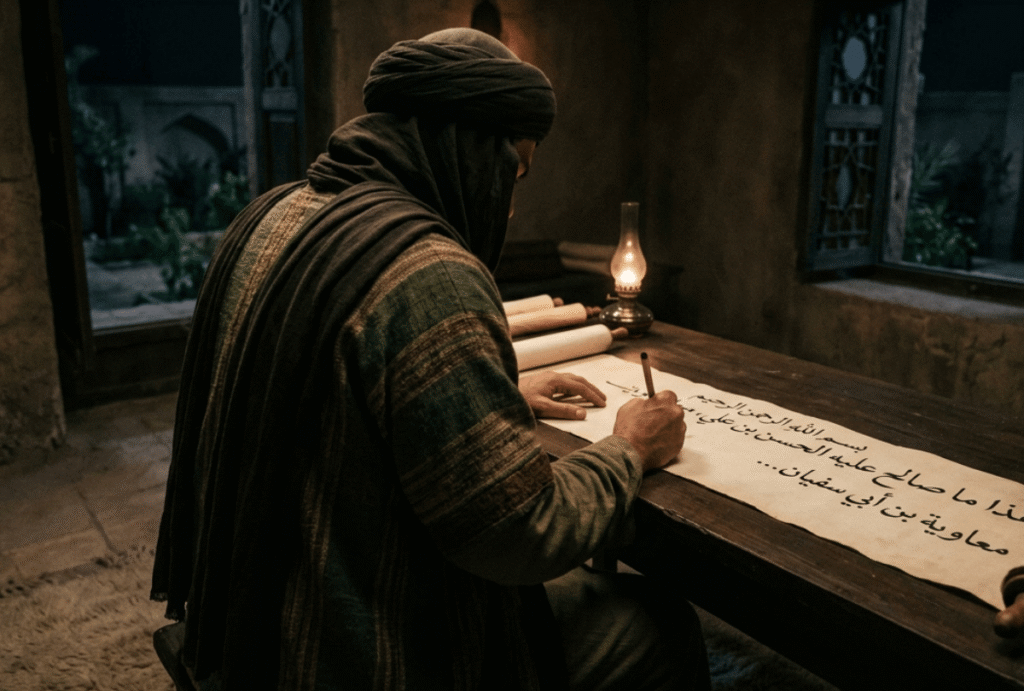
Not every victory in Islam comes through the battlefield.
Some of the most important moments in Islamic history are defined not by war, but by wisdom, patience, and sacrifice.
One of the clearest examples of this is the decision of Imam Hasan (as) to accept a peace treaty with Muawiyah.
At the time, many people were confused. Some even questioned why the grandson of the Prophet Muhammad (saww) would step back from leadership instead of continuing the struggle.
Yet history would reveal that this decision was not retreat – it was protection.
Allah (swt) says in the Holy Qur'an:
“And reconciliation is best.” (4:128)
A choice few understood
When Imam Hasan (as) agreed to the peace treaty, the Muslim community was deeply divided.
His supporters were weakened, betrayal had spread within his own ranks, and continuing conflict risked widespread bloodshed among Muslims.
Many who did not understand the full situation saw the treaty as weakness.
But in reality, it was one of the most courageous decisions in Islamic history.
Imam Hasan (as) chose to preserve life and protect the future of the Ummah over immediate confrontation.
Protecting the ummah
Imam Hasan (as) was faced with an impossible situation.
Continuing war would have meant the loss of countless innocent lives and further division among the followers of Islam.
The peace treaty was not surrender.
It was a calculated decision to protect the integrity of the Muslim community and prevent Islam from being destroyed by internal conflict.
Through this decision, Imam Hasan (as) placed the preservation of the Ummah above personal or political gain.
Exposing the truth
The treaty included conditions that were meant to protect justice and limit oppression.
However, when those conditions were later broken, the reality of Muawiyah’s rule became clear to many who had once been uncertain.
In this way, he safeguarded the message of Islam for future generations.
Different paths, one mission
The lives of Imam Hasan (as) and Imam Hussain (as) are often understood together.
Both faced oppression. Both stood for truth. Both sought to protect the message of Islam.
Yet their approaches were different.
Imam Hasan (as) preserved Islam through patience and peace.
Imam Hussain (as) later preserved it through sacrifice and martyrdom.
Different circumstances required different responses – but the mission remained the same: protecting the truth of Islam.
A legacy of wisdom
The peace treaty of Imam Hasan (as) teaches us an important lesson.
Strength is not always measured by confrontation.
His decision remains one of the most significant and misunderstood moments in Islamic history, yet it was a moment that safeguarded Islam itself.
Frequently asked questions
Why did Imam Hasan (as) make a peace treaty with Muawiyah?
Imam Hasan (as) agreed to the treaty to prevent further bloodshed among Muslims and to protect the unity and survival of the Islamic community.
Was Imam Hasan (as) forced into the treaty?
He was not forced, but he faced extreme internal division, betrayal, and military weakness among his supporters, making continued war unsustainable.
Did the peace treaty mean Imam Hasan (as) gave up leadership?
No. It was a strategic decision to preserve Islam and protect the Ummah, not a surrender of principles or truth.
What was the outcome of the treaty?
The treaty temporarily brought peace but also revealed the political reality of Muawiyah’s rule when its conditions were broken.
How does Imam Hasan’s (as) decision relate to Imam Hussain (as)?
Both Imams (as) aimed to protect Islam. Imam Hasan (as) did so through peace, while Imam Hussain (as) later did so through sacrifice.
What can we learn from Imam Hasan’s (as) decision today?
We learn that wisdom, patience, and long-term thinking can sometimes be more powerful than conflict when protecting truth and justice.
More from blog

Bridging the Digital Divide Through Education
Discover how education and technology can help bridge the digital divide and create equal learning opportunities. Support children with the tools for…
Can Sadaqah Be More Than Money?
Sadaqah isn't only about giving money. Discover how your time, kindness, knowledge and actions can become acts of charity in Islam with…

The Future Starts with Education
Invest in education and help vulnerable children build skills, confidence and opportunity. Support The Zahra Trust’s Back to School appeal today.